
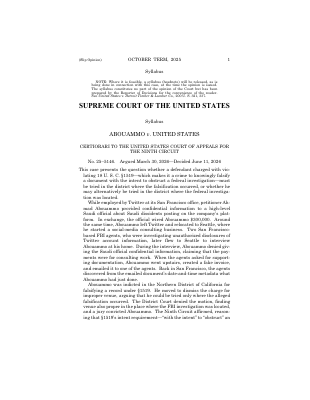
Abouammo v. United States
Case Overview
Abouammo v. United States involves a former Twitter employee convicted of acting as an agent of a foreign government and committing wire fraud by accessing Twitter user data on behalf of Saudi intelligence operatives. The case raises questions about the reach of the Foreign Agents Registration Act (FARA) and related statutes to a private employee who is allegedly recruited by a foreign government but never registers as a foreign agent. It also addresses the overlap between FARA and espionage statutes.
Decision
9-0Opinion of the Court
The Facts
The U.S. government alleges that while an employee at Twitter, Ahmad Abouammo was recruited by an associate of the Saudi crown prince to surveil accounts critical of the Saudi royal family. As part of their investigation into his Saudi ties, FBI agents from the San Francisco office came to his house in Seattle, Washington to interview him. While they were there, Abouammo ran upstairs and quickly fabricated invoices to cover payments he had received. Then he emailed them back down to the agents sitting in his living room (in Seattle). But the agents also received those documents back at their email inboxes in San Francisco. And Mr. Abouammo was criminally indicted for falsifying records in the state of California.
The Issue
Issue: Can Mr. Abouammo be charged with fraud in California for a document he created and emailed in Seattle, just because the email was received in California?
In other words: Whether venue is proper in a district where no offense conduct took place, so long as the statute's intent element "contemplates" effects that could occur there.
The Rules
Whoever knowingly alters, destroys, mutilates, conceals, covers up, falsifies, or makes a false entry in any record, document, or tangible object with the intent to impede, obstruct, or influence the investigation or proper administration of any matter within the jurisdiction of any department or agency of the United States . . . shall be fined under this title, imprisoned not more than 20 years, or both.
In all criminal prosecutions, the accused shall enjoy the right to a speedy and public trial, by an impartial jury of the State and district wherein the crime shall have been committed . . .
The Trial of all Crimes, except in Cases of Impeachment, shall be by Jury; and such Trial shall be held in the State where the said Crimes shall have been committed . . .
Where Congress does not prescribe venue in a criminal statute, the proper venue is determined by identifying the conduct elements of the offense - the physical acts the statute makes criminal - and locating where those acts took place. The defendant's mental state or intent is not a conduct element and cannot be used to fix venue.
The Application
The right to be tried where the crime was committed is one of the oldest protections in American law - and it exists because the British Crown tried to strip it away.
After the Boston Massacre in 1770, Parliament passed a series of laws allowing British soldiers and officials accused of crimes in the colonies to be shipped back to England for trial. The message was clear: if you can move the trial far enough from the community that witnessed the crime, you can control the outcome. Colonial juries who saw what happened would never get to judge it.
The Founders remembered. When they wrote Article III, they required that "the Trial of all Crimes . . . shall be held in the State where the said Crimes shall have been committed." When that wasn't specific enough, they added the Sixth Amendment's Vicinage Clause: trial "by an impartial jury of the State and district wherein the crime shall have been committed."
The question in Abouammo is whether the government did exactly what the British tried to do - moved the trial to a district hundreds of miles from where the defendant actually acted, because the forum was more favorable to the prosecution. Abouammo created and sent the documents in Seattle. He was charged in San Francisco. The government's theory: because the statute's intent element "contemplates" effects in California, venue is proper there. The defense says that reasoning would let the government charge anyone, anywhere an email lands.
Under the conduct elements test, the crime in § 1519 was completed in Seattle - not California. The conduct elements are the verbs: "alters, destroys, mutilates, conceals, covers up, falsifies, or makes a false entry." Abouammo did every one of those things at his desk in Seattle.
The government pointed to the word "knowingly" and to the intent element - "with the intent to impede . . . the investigation" - to argue the crime reached California because the investigation was based there. But "knowingly" is a mens rea element, not a conduct element. The fact that "knowing" was an element of the offense doesn't transform what the defendant knew about into conduct of its own. Abouammo's knowledge of the San Francisco investigation didn't move his hands from Seattle to California. He still typed the invoices in Seattle and pressed send in Seattle.
If mens rea could fix venue, any defendant charged with a federal "knowing" or "willful" crime could be hauled into any district the government connects to the defendant's state of mind. That is exactly the kind of prosecutorial forum-shopping the Vicinage Clause was written to prevent.
This ruling turns on a critical detail: Congress never defined venue in § 1519. The statute says nothing about where a prosecution must be brought. Because Congress was silent, the Court fell back on the default rule from Johnson - look at the conduct elements, find the district where they occurred, and that is the proper venue.
This means the holding is narrow in one important sense. If Congress had written a venue provision into the statute - specifying, for example, that prosecution is proper in any district where the investigation is conducted - the Court would have deferred to that choice. The conduct elements test only fills the gap when Congress doesn't speak.
The Conclusion
**When Congress does not define venue in a criminal statute, the proper venue is the district where the defendant committed the conduct elements of the offense.** A defendant's mental state - even when it is a statutory element - cannot be used to establish venue in a different district. The crime happens where the defendant's hands were, not where the defendant's mind was pointed.
No circuit court data for this case.
Flag an issue
This tracker is maintained by BrynoDC and is free because readers fund it. Support