
Barbara v. Trump (Birthright Citizenship)
Case Overview
On his first day back in office, President Trump signed an executive order reinterpreting the Fourteenth Amendment to deny birthright citizenship to children born in the United States to parents who are not citizens or lawful permanent residents — a reading that conflicts with the amendment's text, 150 years of practice, and the Supreme Court's 1898 decision in United States v. Wong Kim Ark. Federal courts immediately blocked the order nationwide. The Supreme Court heard argument in April 2026 on the universal injunction question and the merits together; a decision is expected before July 4. Bryan's read from oral argument signals is that the government likely loses on the merits, though the universal injunction issue may produce a fragmented ruling. The case is the most significant constitutional question in the current term.
Decision
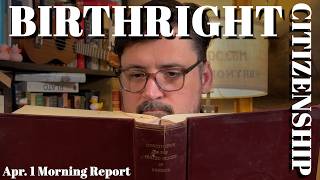
BrynoDC Coverage 1 video
Opinion of the Court
The Facts
On his first day back in office, President Trump signed an executive order reinterpreting the Fourteenth Amendment to deny automatic citizenship to children born in the United States to parents who are not themselves citizens or lawful permanent residents. Multiple district courts immediately enjoined the order. The ACLU and NAACP filed a class action in the District of New Hampshire challenging the order as unconstitutional.
The Issue
Does the Fourteenth Amendment's Citizenship Clause — "All persons born or naturalized in the United States, and subject to the jurisdiction thereof, are citizens of the United States" — guarantee birthright citizenship to children born on U.S. soil regardless of their parents' immigration status?
Can the President reinterpret the Citizenship Clause by executive order?
The Rules
"All persons born or naturalized in the United States, and subject to the jurisdiction thereof, are citizens of the United States and of the State wherein they reside." The disputed phrase is "subject to the jurisdiction thereof."
The Supreme Court held that a child born in San Francisco to Chinese immigrant parents — who were themselves ineligible for citizenship under the Chinese Exclusion Act — was a U.S. citizen under the Fourteenth Amendment. The Court read "subject to the jurisdiction thereof" broadly, excluding only children of foreign diplomats and enemy forces.
The Court held that a Native American born on a reservation was not "subject to the jurisdiction" of the United States at birth because tribal nations exercised separate sovereignty. This case was effectively superseded by the Indian Citizenship Act of 1924.
The Application
The executive order argues that "subject to the jurisdiction thereof" should be read narrowly — that children born to parents who are in the country illegally or on temporary visas are not "subject to the jurisdiction" of the United States in the constitutional sense. The government relies on the original public meaning of the phrase at ratification, arguing it was understood to require complete allegiance, not merely physical presence.
Challengers argue this reading contradicts 125 years of settled law since Wong Kim Ark. Every federal court to consider the question has held that virtually all children born on U.S. soil are citizens, regardless of their parents' status. The only recognized exceptions are children of foreign diplomats with immunity and children of invading enemy forces — narrow categories that have never been extended to immigrant families.
The Supreme Court granted certiorari on December 5, 2025, and heard oral arguments on April 1, 2026. The case has enormous practical stakes: the executive order, if upheld, could retroactively affect the citizenship status of millions of people born in the United States. It also raises a separation-of-powers question — whether the President can unilaterally reinterpret a constitutional amendment without a court ruling or new legislation.
The Conclusion
Pending decision. A ruling for the government would overturn Wong Kim Ark and fundamentally redefine American citizenship for the first time since the Fourteenth Amendment was ratified in 1868.
No circuit court data for this case.
Flag an issue
This tracker is maintained by BrynoDC and is free because readers fund it. Support