
Cook v. Trump (Fed Reserve independence)
Case Overview
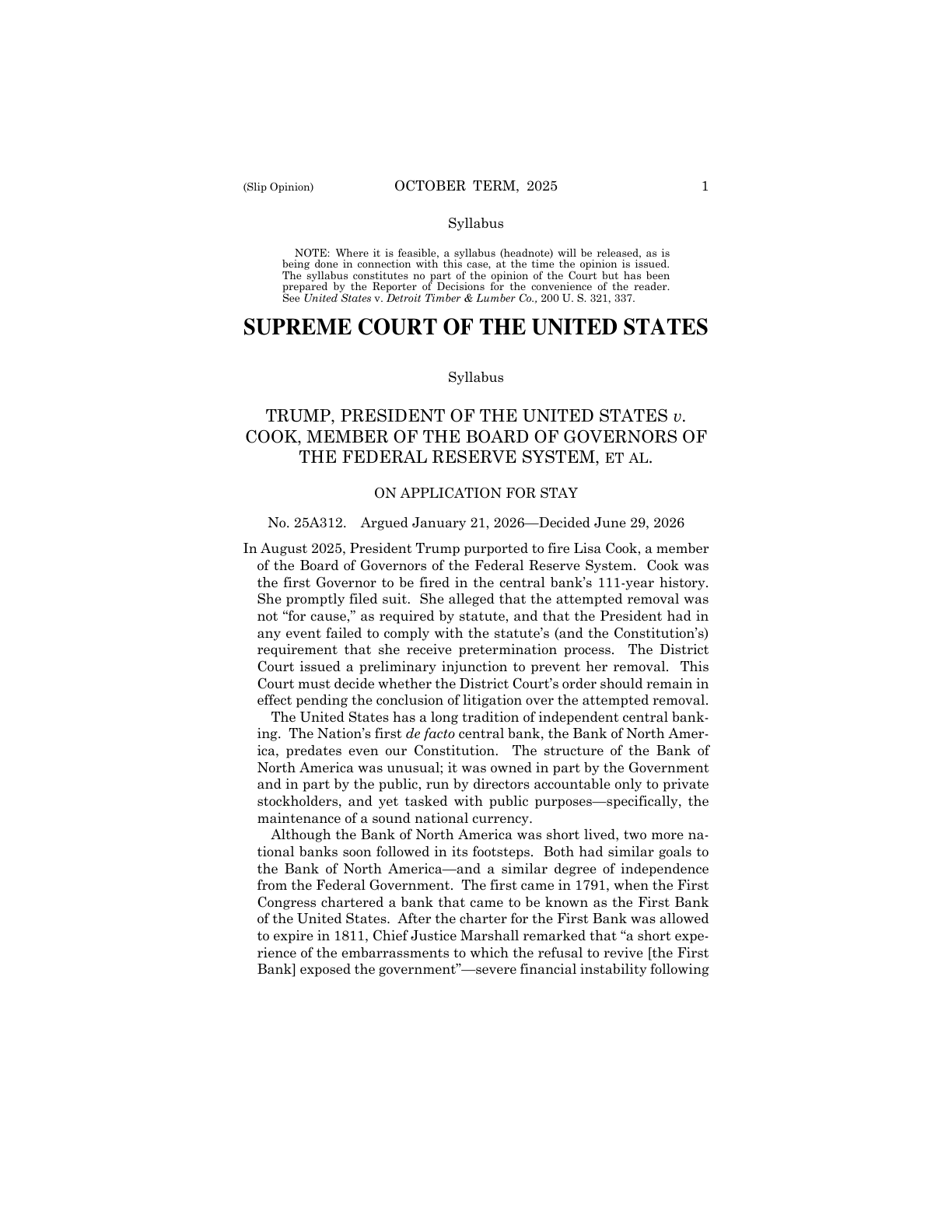
The case, docketed as Trump v. Cook (25A312) at the Supreme Court, involves presidential removal power in tension with Federal Reserve Board independence. The administration argues members lack due process protections without explicit statutory scheme and that the district court lacked jurisdiction to order reinstatement. Doctor Cook responds by citing historical precedent for for-cause tenure and judicial protection of offices pending review, with the Supreme Court scheduled for oral arguments on January 21, 2026, though no ruling has been issued yet.
Decision
BrynoDC Coverage 1 video
Opinion of the Court
The Facts
President Trump attempted to fire Federal Reserve Governor Lisa Cook from the Board of Governors. Cook sued in the U.S. District Court for the District of Columbia, arguing that the Federal Reserve Act provides for-cause removal protection — governors serve fourteen-year terms and may only be removed "for cause." The district court granted a preliminary injunction allowing Cook to remain in her position. The government appealed.
The Issue
Does the President have constitutional authority to remove a Federal Reserve Board governor at will, notwithstanding the Federal Reserve Act's for-cause removal protections?
Does the unitary executive theory that challenges Humphrey's Executor extend to the Federal Reserve — the central bank of the United States?
The Rules
Congress may limit the President's power to remove officials of independent regulatory agencies to removal only for cause. The companion case Slaughter v. Trump (No. 25-332) directly challenges this precedent.
Members of the Board of Governors serve fourteen-year terms and may be removed by the President only "for cause." The Fed's statutory independence is designed to insulate monetary policy from short-term political pressure.
"The executive Power shall be vested in a President." The government argues this grants plenary removal authority over all officers exercising executive power, regardless of statutory for-cause protections.
The Application
Judge Cobb in the D.D.C. granted a preliminary injunction, finding Cook was likely to succeed on the merits — existing precedent protects Fed governors from at-will removal. The government appealed to the D.C. Circuit (No. 25-5326).
The Supreme Court took the case on an expedited track alongside Slaughter v. Trump, hearing oral arguments on January 21, 2026. While Slaughter asks whether the President can fire FTC commissioners, Cook raises the stakes: the Federal Reserve's independence is considered foundational to economic stability. Markets react to any signal that the Fed is subject to political control.
A ruling against Cook would not only strip the Federal Reserve of its structural independence but, combined with Slaughter, would signal that every independent agency in the federal government — the SEC, FCC, NLRB, FDIC, and dozens more — is subject to presidential removal power. The economic implications extend far beyond the legal question.
The Conclusion
The Supreme Court held 5-4 that Federal Reserve governors are protected from presidential removal without cause, upholding the reinstatement of Governor Lisa Cook. Chief Justice Roberts wrote for the Court; Thomas, Alito, Gorsuch, and Barrett dissented.
No circuit court data for this case.


Flag an issue
This tracker is maintained by BrynoDC and is free because readers fund it. Support