
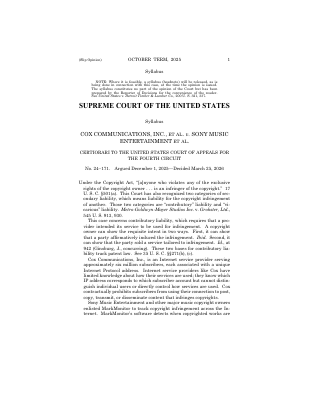
Cox Communications, Inc. v. Sony Music Entertainment
Decision
BrynoDC Coverage 1 video
Opinion of the Court
The Facts
Cox Communications is an Internet service provider serving six million subscribers. MarkMonitor, hired by Sony Music and other copyright owners, detected copyright infringement activity and sent Cox 163,148 notices identifying subscriber IP addresses associated with piracy. Sony sued Cox for secondary copyright liability, alleging both contributory infringement (providing service knowing customers would infringe) and vicarious liability (failing to control customer infringement). A jury found Cox liable on both theories and awarded $1 billion in damages for willful infringement.
The Issue
Whether an Internet service provider is contributorily liable for copyright infringement by its users, and what standard applies to determine when an ISP "intends" to induce or facilitate infringement.
Sony argued that Cox's continued service provision to subscribers known to be infringing was sufficient for contributory liability. Cox argued that merely providing Internet access with knowledge of infringement does not amount to intent to induce or tailor service to infringement, and that ISPs should not face billion-dollar liability for customer conduct they cannot directly control.
The Rules
Anyone who violates any exclusive right of a copyright owner is an infringer.
Secondary copyright liability includes contributory liability (intent that service be used for infringement) and vicarious liability (financial interest + right and ability to control infringement). Requires affirmative inducement or service tailored to infringement.
A provider is contributorily liable only if it intended that the provided service be used for infringement, shown either by actively inducing infringement or providing a service tailored to that infringement. Passive knowledge is insufficient.
The Application
The Internet created a problem for copyright owners. Millions of people upload and download music without paying. ISPs sit in the middle—they provide the pipes but have limited visibility into customer conduct. They know their IP addresses sometimes map to infringing conduct (because copyright holders send notices), but they do not control individual users' behavior. Sony faced a choice: sue the uploaders (often judgment-proof), sue the ISP (a solvent corporation), or negotiate licensing. The case became a proxy for who bears the burden of copyright enforcement in a decentralized network.
Contributory liability in copyright comes in two varieties. First, active inducement: if you market a tool saying "use this to copy protected works," you are liable. Grokster was about that. Second, providing a service specifically designed and marketed for infringement. But general-purpose ISPs are not designed for infringement—they are designed for communication. Cox provides Internet service to millions of people for lawful purposes. That some customers use it to infringe does not make Cox the architect of infringement. Intent requires either active inducement or service tailored to infringement. Knowing that some customers infringe, without more, does not meet that standard.
The Conclusion
**The Supreme Court held that Cox Communications is not contributorily liable because it neither affirmatively induced infringement nor provided a service tailored to that infringement.** Merely continuing to provide Internet service to subscribers known to be infringing does not constitute the intent required for contributory liability. The judgment for Sony on the contributory liability theory was reversed.
The decision reaffirms that secondary copyright liability requires more than knowledge. It requires conduct aimed at infringement or a service architecture designed for it. General-purpose tools and services get protection, even if some users misuse them. This principle matters not just for ISPs but for search engines, cloud services, and all infrastructure providers who serve millions of users and inevitably encounter infringement.
No circuit court data for this case.
Flag an issue
This tracker is maintained by BrynoDC and is free because readers fund it. Support