
Fernandez v. United States
Decision
6-2-1BrynoDC Coverage 1 video
Opinion of the Court
The Facts
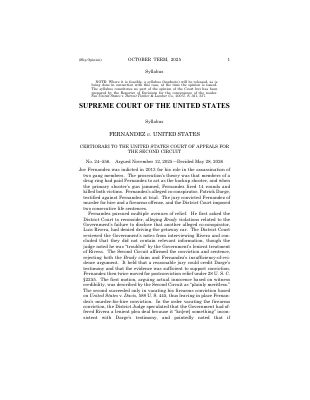
Joe Fernandez is serving two consecutive life sentences for a 2013 murder-for-hire in New York. Prosecutors said members of a drug ring paid him $40,000 to be the backup shooter in an assassination; when the primary shooter's gun jammed, Fernandez fired 14 rounds and killed both targets. His conviction rested heavily on testimony from his cousin and alleged co-conspirator, Patrick Darge. Years later, after one of his convictions was thrown out on an unrelated legal ground, the trial judge expressed doubt about whether Darge's testimony was reliable and granted Fernandez a compassionate release, reducing his sentence. The government appealed, and the case went all the way to the Supreme Court.
The Issue
The precise question before the Court was whether 18 U.S.C. §3582(c)(1)(A)(i), the compassionate release statute, allows a federal prisoner to argue that his conviction was fundamentally flawed as a reason to reduce his sentence, or whether that kind of argument must go exclusively through 28 U.S.C. §2255, the federal habeas corpus statute.
Fernandez argued that if a man is sitting in prison on a conviction he says was obtained with false testimony and suppressed evidence, there is no more extraordinary and compelling reason imaginable to shorten his sentence, and the compassionate release statute should have room for that argument. The government argued the opposite: Congress created §2255 specifically to handle attacks on conviction validity, surrounded it with strict procedural rules, and Fernandez cannot use compassionate release to bypass all of those rules just because §2255 is now closed to him.
The Rules
Courts may reduce a sentence when "extraordinary and compelling reasons" warrant such a reduction; the statute contains almost no other procedural requirements beyond an initial presentation to the Bureau of Prisons.
Federal prisoners may move to "vacate, set aside or correct" a sentence imposed "in violation of the Constitution or laws of the United States"; the statute carries strict constraints: a one-year time limit, a general rule of one motion per prisoner, a bar on relitigating claims already decided on direct appeal, and a requirement of "cause and prejudice" or actual innocence for claims not raised earlier.
Prisoners may not use a general-purpose statute to challenge the validity of their confinement when Congress has created a specific habeas statute to govern such claims; claims "close to the core of habeas corpus" must go through the designated channel.
A prisoner cannot use a general procedural mechanism (there, Federal Rule of Civil Procedure 60(b)) to argue that a denial of habeas relief was wrong, because doing so would "circumvent" the strict statutory standards Congress built into the habeas framework.
"Rehabilitation of the defendant alone shall not be considered an extraordinary and compelling reason" for compassionate release; the Commission may, however, treat rehabilitation as one factor among others.
A freestanding claim of actual innocence, without an accompanying constitutional violation, has never been recognized as an independent ground for federal habeas relief; actual innocence functions primarily as a gateway to reach otherwise procedurally barred claims.
The Application
For the better part of a decade, Joe Fernandez tried every route available to him inside the federal system. He appealed his conviction and lost. He filed a §2255 habeas petition claiming actual innocence and lost. He filed a second §2255 petition on a different theory (that one of his firearms convictions was based on an unconstitutionally vague statute) and actually won on that narrower point, getting one conviction vacated. But his murder-for-hire sentence remained, and §2255 was now effectively closed to him for any further challenges.
That is when the district judge's expression of "disquiet" about the original verdict opened a new door. The judge said he had doubts about Patrick Darge's credibility, concerns about whether the government had withheld evidence (a Brady violation), and uncertainty about whether the jury got it right. On the basis of those doubts, he granted Fernandez compassionate release. The practical effect: a man who had exhausted every habeas avenue found relief through a statute Congress designed for terminally ill prisoners and elderly inmates with failing health.
The core tension the Court had to resolve was not really about Fernandez's guilt or innocence. It was about what happens when Congress builds a specific, rigorous procedure for one kind of claim and a prisoner uses a different, easier procedure to make the same argument. That is a structural question about the federal court system, and it is the question Barrett's majority opinion is actually answering.
Barrett's majority rests on what the Court calls the "anticircumvention principle," drawn from two older cases. In Preiser (1973), the Court held that prisoners could not use the broad civil rights statute (§1983) to challenge their confinement because Congress had already built a specific habeas statute for that purpose. In Gonzalez (2005), the Court held that prisoners could not use a general civil procedure rule to relitigate a lost habeas claim. The lesson from both: when Congress creates a specific procedure with tight limits for a specific kind of claim, it means those limits to stick. You cannot walk around them by repackaging the argument under a different statute.
The majority applies that principle to §3582 by looking at what the statute is and is not designed to do. The very label "Compassionate Release" signals the point. The statute's explicit examples, terminally ill prisoners, elderly inmates with declining health, rehabilitated prisoners, all describe personal circumstances unrelated to legal error. The Bureau of Prisons runs the intake process, and as Barrett notes, the Bureau's expertise is in "safekeeping, care, subsistence, protection, instruction, and discipline," not in evaluating Brady claims or assessing witness credibility from a cold trial record. Congress did not route this through an agency that has no competence to evaluate it by accident.
There is also a remedies mismatch the majority finds telling. If Fernandez is right that his conviction is fundamentally flawed, the remedy for that wrong is to vacate the conviction, which is exactly what §2255 authorizes. Compassionate release can only reduce a sentence. A reduced sentence does not undo a wrongful conviction. The majority reads that gap as confirmation that §3582 was never designed to address conviction validity in the first place.
Finally, there is Fernandez's own candor. He admitted at oral argument that the appeal of his approach was avoiding §2255's "harsh limitations." The majority treats this as a concession that his strategy was to use §3582 as an end-run, not as a genuinely distinct avenue of relief. Barrett writes that his approach would let prisoners challenge convictions "repeatedly, for years after they became final, and regardless whether the issues had already been raised or decided in prior proceedings."
The vote count matters here. Sotomayor and Kagan did not join the majority opinion. They agreed the Second Circuit's reversal should be affirmed, but they refused to endorse Barrett's habeas-channeling framework. That makes the 6-2-1 split unusual: eight justices ruled against Fernandez, but only six agreed on why.
Sotomayor's concurrence in the judgment offers a narrower, more targeted reason to reject what happened in the district court. Her argument is essentially this: compassionate release is about changed circumstances, things that happened after sentencing that alter the equation. It is not a mechanism for a judge to announce, years later, that he is having second thoughts about the original trial evidence. Fernandez litigated the credibility of Darge's testimony and the strength of the government's case from day one, through trial, sentencing, direct appeal, and two §2255 motions. Nothing new happened. The district judge simply reconsidered old evidence and reached a different conclusion. Sotomayor would hold that is not what compassionate release is for, without reaching the broader question of whether conviction challenges can ever qualify.
Her caveat lands as a direct criticism of Barrett: "bad facts often make bad law." Sotomayor is warning that Fernandez was the wrong vehicle for announcing a broad categorical rule, and that the majority's habeas-channeling analysis could produce consequences the Court has not thought through. That kind of internal disagreement among the justices who agree on the outcome is rare and worth noticing.
Jackson's solo dissent takes the opposite view from the majority at every step. On text, she argues that "extraordinary and compelling" describes degree, not category. Nothing in those words excludes conviction-related arguments. On structure, she reads Congress's 2018 expansion of compassionate release (the First Step Act, which let prisoners file their own motions after the Bureau badly underutilized the program) as a signal that Congress wanted the standard interpreted broadly, not narrowly. On remedies, she argues the majority misses the point: habeas vacates a conviction as a matter of law, while compassionate release shortens a sentence as a matter of grace. They are different tools aimed at different results. An innocent man stuck in prison is, she argues, the exact situation a safety-valve statute was designed for. Jackson would have sent the case back to the Second Circuit to evaluate whether the district court properly applied the "extraordinary and compelling" standard, without the categorical bar the majority now imposes.
The 6-2-1 alignment reflects something real: even among the justices who want the same outcome for Fernandez, there is no consensus on the theory. That limits the precedential force of the majority's habeas-channeling analysis and leaves open questions that lower courts will have to sort through.
The Conclusion
**The Court held that a federal prisoner may not use the compassionate release statute to challenge the validity of his conviction.** Such claims must go through habeas corpus under 28 U.S.C. 2255, even when that avenue is procedurally closed. The 6-2-1 split limits the precedential force of the majority's reasoning, and Sotomayor's concurrence leaves open whether changed circumstances after sentencing could still qualify.
No circuit court data for this case.
Flag an issue
This tracker is maintained by BrynoDC and is free because readers fund it. Support