
First Choice Women's Resource Centers, Inc. v. Davenport
Decision
Opinion of the Court
The Facts
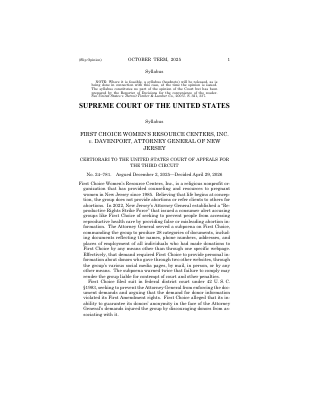
First Choice Women's Resource Centers is a religious nonprofit in New Jersey that counsels pregnant women from a pro-life perspective and does not provide or refer for abortions. In 2022, New Jersey's Attorney General established a 'Reproductive Rights Strike Force' and issued a consumer alert accusing groups like First Choice of spreading false abortion information. The Attorney General subpoenaed First Choice for records about its funding, donors, and communications.
The Issue
Whether a nonprofit organization has Article III standing to challenge a state attorney general's subpoena on First Amendment grounds, even before the state has initiated an enforcement action or prosecution.
First Choice argued it suffered a present injury to its First Amendment associational rights because the subpoena itself, and the state's public accusations, chilled its speech and fundraising. The state argued First Choice's injury was speculative and that litigation must await actual enforcement or prosecution.
The Rules
A party seeking federal judicial review must have injury in fact, causation, and redressability. Injury must be concrete, particularized, and actual or imminent, not speculative or generalized.
An actual injury to First Amendment rights—such as chilling of speech, deterrence of association, or harm to reputation—is concrete and sufficient for Article III standing, even if no prosecution has occurred.
The First Amendment protects freedom of speech, worship, publication, assembly, and petition. It includes protection for organizational autonomy and associational privacy.
The Application
First Amendment challenges to government investigations have always been delicate. The government has legitimate power to investigate potential fraud or violations of law. But that power can be weaponized. When an Attorney General issues a consumer alert naming an organization as spreading 'false or misleading' information, and then subpoenas that organization, the message is clear: your speech is dangerous and the state is watching. For donors, supporters, and the organization itself, the chill is immediate. You don't have to wait for an actual prosecution to suffer a First Amendment injury. The injury happens when the state's power is deployed to deter speech.
A present injury to First Amendment rights need not be speculative. If the state has already issued a public accusation and served a subpoena, the injury to associational rights is concrete and actual. Donors may withdraw support, volunteers may fear association, and the organization must divert resources to compliance. These are real harms, not hypothetical ones. The Third Circuit had wrongly insisted on waiting for prosecution, but First Amendment doctrine has long recognized that official harassment and investigation can constitute injury even absent prosecution.
The Conclusion
**The Supreme Court held that First Choice has established a present injury to its First Amendment associational rights sufficient for Article III standing.** The Attorney General's subpoena and public accusations constitute concrete injury, not speculation. The Third Circuit's judgment was reversed, and the case was remanded for resolution of the First Amendment merits.
The decision protects nonprofits, advocacy groups, and speakers from being frozen out of court while the state deploys investigative power against them. You need not wait for prosecution to challenge official harassment of expressive activity.
No circuit court data for this case.
Flag an issue
This tracker is maintained by BrynoDC and is free because readers fund it. Support