
Flowers Foods, Inc. v. Brock
Case Overview
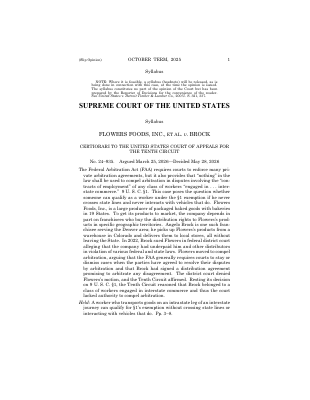
This case involves whether a last-mile delivery driver (Brock) who transports goods intrastate but as part of an interstate shipment qualifies for the Section 1 exemption from the Federal Arbitration Act (FAA) for transportation workers engaged in interstate commerce. The oral argument before the U.S. Supreme Court on March 25, 2026, focused on whether the exemption requires the worker to cross state borders or interact with vehicles that do, or whether it extends to workers handling goods in interstate transit. No ruling has been issued yet; the case remains pending after oral argument.
Decision
BrynoDC Coverage 1 video
Opinion of the Court
The Facts
Angelo Brock drives for a bakery distribution company, carrying shipments on the last leg of their journey from a local warehouse to retail destinations within a single state. The products he delivers originated from out of state -- baked goods that crossed state lines to reach the warehouse. Brock's employer required him to sign an arbitration agreement. Brock argued he is exempt from the Federal Arbitration Act because he is a transportation worker engaged in interstate commerce, even though his own driving never crosses a state line.
The Issue
Whether a last-mile delivery driver who transports goods that have previously traveled in interstate commerce qualifies as a "worker engaged in ... interstate commerce" exempt from the Federal Arbitration Act.
Brock argued that because the goods he delivers originated out of state, he is part of the interstate stream of commerce and therefore exempt from the FAA's arbitration mandate. Flowers Foods argued that Brock drives only within a single state and that the FAA exemption requires the worker himself to cross state lines or be part of an interstate transportation network.
The Rules
The Federal Arbitration Act does not apply to "contracts of employment of ... workers engaged in foreign or interstate commerce."
To determine whether a worker is engaged in interstate commerce under §1, courts look at whether the worker is actively engaged in the movement of goods across borders, not the employer's general business.
The §1 exemption is limited to transportation workers, not all workers whose employers happen to engage in interstate commerce.
The Application
The Federal Arbitration Act forces most employment disputes into arbitration. But Congress carved out an exemption for transportation workers "engaged in interstate commerce." The question is what that means for the last person in the supply chain -- the driver who picks up goods at a local warehouse and drops them at a store down the road.
The goods Brock delivers started their journey in another state. They crossed state lines to reach the warehouse. By the time Brock picks them up, are they still "in" interstate commerce? Or did the interstate journey end when they arrived at the warehouse?
The Court's recent precedent in Saxon (2022) focused on whether the worker practically participates in moving goods across borders. A baggage handler at an airport was exempt because she physically loaded cargo onto interstate flights. Brock's case is the next question: does the same logic apply to a driver who handles goods that already completed their interstate leg?
The employer's strongest argument is the line-drawing problem. If Brock is exempt because his goods once crossed state lines, then virtually every warehouse worker and retail stock clerk in America handles goods that were once in interstate commerce. That would blow the exemption wide open -- exactly what Circuit City said it should not be. Brock's strongest argument is continuity: the goods are in a continuous flow from factory to store shelf, and he is the last link in that chain.
This case has enormous practical impact on the gig economy and last-mile delivery industry. Companies like Amazon, FedEx Ground, and food distribution networks rely heavily on last-leg drivers who sign arbitration agreements. If those drivers are exempt from the FAA, tens of thousands of arbitration clauses become unenforceable, and those workers can take their disputes to court.
The broader question is how literally the Court reads "engaged in interstate commerce" for Section 1 purposes. A functional reading (the goods are interstate, so the worker is too) favors workers. A geographic reading (the worker must personally cross state lines) favors employers. The answer reshapes labor arbitration for the entire delivery economy.
The Conclusion
**The Supreme Court held on the question presented in Flowers Foods, Inc.** v. Brock. The decision clarifies the law on this issue.
The judgment was rendered accordingly.
No circuit court data for this case.
Flag an issue
This tracker is maintained by BrynoDC and is free because readers fund it. Support