
FS Credit Opportunities Corp. v. Saba Capital Master Fund, Ltd.
Case Overview
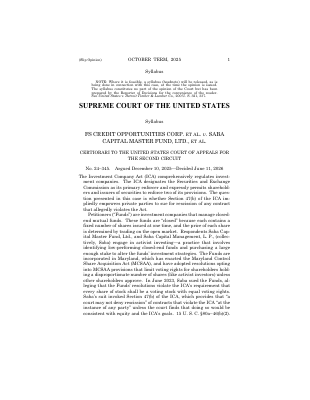
FS Credit Opportunities Corp. v. Saba Capital Master Fund addresses whether activist hedge funds that acquire large stakes in closed-end mutual funds can use their voting power to force the funds to convert to an 'interval fund' structure that would require the fund to periodically redeem shares — effectively forcing a form of liquidation. The Investment Company Act of 1940 governs closed-end fund structure, and the case examines whether fund boards may implement defensive measures to block shareholder-driven conversions.
Decision
BrynoDC Coverage 1 video
Opinion of the Court
The Facts
Saba Capital is a hedge fund that buys large stakes in closed-end mutual funds, then uses its voting power to pressure management into changing strategy or liquidating. FS Credit Opportunities Corp. and several other closed-end funds fought back by incorporating under Maryland's Control Share Acquisition Act, a state anti-takeover law that strips voting rights from shareholders who accumulate an outsized position unless other shareholders vote to restore them. Saba, blocked from wielding its shares, argued the Maryland law violated a federal rule requiring every share of a closed-end fund to carry equal voting rights. To get those resolutions unwound, Saba reached for Section 47(b) of the Investment Company Act, a provision that says courts "may not deny rescission" of contracts that violate the Act. The question was whether Section 47(b) gives investors like Saba the right to walk into federal court and demand that result in the first place.
The Issue
Whether Section 47(b) of the Investment Company Act implicitly creates a private right of action, meaning whether it gives individual investors the power to sue in federal court to rescind contracts they believe violate the Act.
Saba argued that Section 47(b)'s command that a court "may not deny rescission at the instance of any party" signals congressional intent to let private parties bring rescission suits. The Funds countered that Section 47(b) is addressed to courts exercising their remedial power, not to plaintiffs looking for a ticket into federal court. Enforcement of the Investment Company Act, the Funds argued, belongs to the SEC, and Congress said so by giving the SEC broad enforcement authority and expressly creating only two narrow private rights of action elsewhere in the statute.
The Rules
A contract that violates the Investment Company Act is unenforceable by either party; and to the extent such a contract has been performed, a court may not deny rescission unless denial would produce a more equitable result consistent with the Act's purposes.
Every share of stock issued by a registered management company shall be a voting stock and have equal voting rights with every other outstanding voting stock.
An action may be brought by a security holder of a registered investment company on behalf of such company for breach of fiduciary duty against certain members of the company.
To create a private right, a statute must use rights-creating language aimed at protecting a particular class of persons; language that focuses on the person regulated rather than the individuals protected does not suffice.
A provision that is a mandate directed to courts, rather than one that confers a right on a specified class of persons, does not create a private cause of action.
Section 215 of the Investment Advisers Act, by declaring certain contracts void, fairly implies a right to seek rescission in a federal court; the legal consequences of voidness include the availability of a suit to have the contract rescinded.
The Application
Closed-end funds are a specific kind of investment company. Unlike a typical mutual fund, which expands and contracts as investors buy in and cash out, a closed-end fund issues a fixed number of shares, and those shares trade on the open market just like stock. The fund's managers invest a pool of money according to their strategy. Once the shares are out, investors who want to exit sell to someone else on the market rather than cashing out from the fund.
That structure makes closed-end funds a target for a particular kind of activist investor. A hedge fund can buy up a large position at a discount to the fund's underlying assets, then use its voting power to force a change: convert the fund to an open-end structure (forcing a payout at asset value), liquidate the portfolio, or install new management. The activist wins regardless of whether the change is good for long-term investors. The existing managers and other shareholders lose.
Saba Capital is exactly that kind of activist. It bought a substantial stake in FS Credit and several related funds with this playbook in mind. The Funds responded by invoking the Maryland Control Share Acquisition Act, a state law designed to neutralize exactly this tactic. Under the MCSAA, a shareholder who accumulates shares beyond a certain threshold loses the voting rights attached to those excess shares, unless and until the other shareholders vote to restore them. Saba's position crossed that threshold, and the Funds adopted resolutions implementing the MCSAA's restrictions.
Saba argued those resolutions violated a federal rule in the Investment Company Act: every share of a registered closed-end fund "shall be a voting stock and have equal voting rights with every other outstanding voting stock." The substantive merits of that argument were not before the Supreme Court. What the Court had to decide was narrower: did Saba even have the right to sue under Section 47(b) to force rescission of the resolutions?
Justice Barrett opened the majority opinion with a sentence that set the frame for everything that followed: "Congress, not the Judiciary, decides who may enforce the law." That principle, she wrote, means courts do not get to invent private lawsuits just because a statute prohibits something. If Congress wanted private parties to be able to sue for rescission of contracts that violate the Investment Company Act, Congress needed to say so. And it did not.
The textual argument begins with what Section 47(b) actually says. The provision tells courts that when a contract violating the Act has been performed, "a court may not deny rescission." Barrett's key move: that sentence addresses what a court must do once a party is already before it, not whether any party has the right to be there. "Rescission" is a remedy, not a cause of action. Under common law, once a contract is fully performed it is very difficult to unwind. Section 47(b) was written to change that rule for courts dealing with contracts that violate the ICA. It says: even if the contract is already done, a court cannot refuse to rescind it on that ground alone. It does not say: and here is your ticket to federal court.
The 1980 amendments are where the majority turns Saba's best argument against it. Before 1980, Section 47(b) used the language "shall be void." In 1979, the Supreme Court had held in a parallel case (Transamerica Mortgage Advisors, Inc. v. Lewis, known as TAMA) that nearly identical language in a related statute implied a private right of action, because declaring a contract void naturally means someone can go to court to have it declared so. Saba argued that TAMA should control. Barrett responded by pointing to what Congress did one year after TAMA: it deleted "shall be void" from Section 47(b) and rewrote the provision to focus on what a court must do. That change, Barrett concluded, deliberately distinguished Section 47(b) from the statute TAMA had interpreted. "Changed language typically indicates changed meaning."
The structural argument reinforces the textual one. The Investment Company Act gives the SEC broad authority to investigate and bring enforcement actions. It expressly creates two private rights of action in other provisions, including one that lets shareholders sue investment advisers for breach of fiduciary duty and spells out exactly how that suit works: burdens of proof, damages caps, forum. When Congress creates a private right of action with that level of detail somewhere else in the same statute, and says nothing of the kind in Section 47(b), the inference is that Congress meant the difference.
Justice Jackson, joined by Justices Sotomayor and Kagan on the key points, argued that the majority got the 1980 amendments exactly backwards. The question was not just what Congress wrote in the new text. The question was why Congress wrote it.
Her account: In 1940, Congress enacted both the Investment Company Act and the Investment Advisers Act simultaneously. Both contained parallel provisions making illegal contracts "void." When TAMA interpreted the IAA version and found an implied right of action, that holding necessarily covered Section 47(b) too, because the two provisions were identical in origin. Then in 1980, Congress amended the ICA's version. Jackson's reading: the Committee Reports from both the House and Senate explained exactly what Congress was doing. The committees said they intended courts to continue implying private rights of action "to the same extent" they had been implied under the original statute. They also noted that the SEC, with a small staff, could not be expected to police every violation, and that private lawsuits would "fill that gap."
Jackson's sharpest point is a question she puts to the majority: if Congress wanted to undo TAMA's recognition of an implied right of action, why did it not say so anywhere? Not in the text, not in the legislative record. The majority's answer, she argued, amounts to guessing from changed language what Congress "typically" intends, while ignoring the actual documents in which Congress explained what it intended.
The deeper disagreement is about how courts should read statutes. Barrett's majority treats legislative history (committee reports) with skepticism, preferring to work from text and structure. Jackson argues that committee reports are not random fragments of congressional opinion: they are formal documents, circulated to all members before a vote, that function as the official explanation of what a bill does. Refusing to read them, she wrote, is not a neutral choice. It is choosing to let the text say less than Congress intended it to say.
The Conclusion
**The Supreme Court held, 6-3, that Section 47(b) of the Investment Company Act does not give private parties the right to sue for rescission of contracts they believe violate the Act.** The provision addresses what courts must do with rescission as a remedy; it is not a grant of standing to sue. Enforcement of the Act belongs to the SEC, and the two private rights of action Congress did create elsewhere in the statute show Congress knew how to write one when it wanted to.
No circuit court data for this case.
Flag an issue
This tracker is maintained by BrynoDC and is free because readers fund it. Support