
Galette v. New Jersey Transit Corp.
Case Overview
Galette v. New Jersey Transit Corp. addresses whether NJ Transit is an arm of the state entitled to Eleventh Amendment immunity from suit in federal court. Two plaintiffs injured in NJ Transit bus accidents sued in federal court, and NJ Transit claimed Eleventh Amendment sovereign immunity. The case turns on the multi-factor arm-of-state test and whether NJ Transit's financial independence from the state treasury is sufficient to strip it of immunity, with the decision potentially barring injured plaintiffs from federal courts.
Decision
BrynoDC Coverage 1 video
Opinion of the Court
The Facts
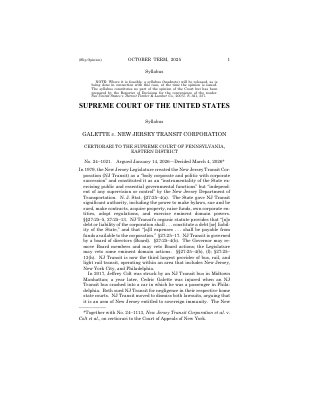
In 2017, Jeffrey Colt was struck by an NJ Transit bus in Midtown Manhattan. A year later, Cedric Galette was a passenger in a car in Philadelphia when an NJ Transit bus crashed into it. Both were seriously injured. Both sued NJ Transit for negligence in their respective home state courts. NJ Transit moved to dismiss both lawsuits, arguing it is an arm of New Jersey entitled to sovereign immunity. The New York Court of Appeals said NJ Transit is not an arm of the state; the Pennsylvania Supreme Court said it is. The Supreme Court took the cases to resolve the conflict.
The Issue
Whether New Jersey Transit Corporation is an "arm of the State" of New Jersey, and therefore entitled to share in the State's sovereign immunity from suit in other states' courts.
NJ Transit argued it is an "instrumentality" of the state exercising essential governmental functions, with heavy state control and funding, and therefore entitled to New Jersey's immunity. Galette and Colt argued NJ Transit is a corporation with separate legal personality -- it can sue and be sued, hold property, make contracts, and is liable for its own debts -- making it legally independent from the State, the same way cities and counties are.
The Rules
Sovereign immunity is "'personal' to the State" and extends only to arms of the State itself, not to legally independent entities the State creates.
A state-chartered bank was not an arm of Georgia because it was a "corporation" and judgments would be satisfied by the corporation's property, not the State's. The State, "by giving to the Bank the capacity to sue and be sued, voluntarily strips itself of its sovereign character."
Courts should focus on whether the State structured the entity as legally separate and liable for its own judgments. State control is not dispositive because "ultimate control of every state-created entity resides with the State." Gauging actual control is a "'perilous inquiry'" and "'unreliable.'"
NJ Transit was created as a "body corporate and politic with corporate succession" with powers to sue and be sued, enter contracts, acquire property, and exercise eminent domain. The statute provides that "[n]o debt or liability of the corporation shall ... constitute a debt [or] liability of the State."
A central rationale for sovereign immunity is protecting States' "ability to make [their] own decisions about 'the allocation of scarce resources.'" If the State is formally liable for judgments against an entity, that entity is more likely an arm of the State.
Whether an entity is an arm of the State is a question of federal law answered by examining the "provisions of state law that define the agency's character."
The Application
Sovereign immunity protects states from being sued in other states' courts without their consent. But that protection is personal to the state itself. It does not automatically extend to every entity the state creates. The question is whether the entity is really part of the state, or whether the state set it up as a legally separate thing.
The Court traced two centuries of cases answering this question. The earliest cases focused on the corporate form. At common law, a "corporation" was an artificial person that could sue and be sued on its own. In 1824, the Court held a state-chartered bank was not Georgia's arm because it was a corporation liable for its own debts. That principle held even when states were sole shareholders, appointed all officers, and managed the bank's affairs.
By the mid-20th century, the Court looked at additional factors but kept the same focus: did the state structure the entity as legally separate? In Moor v. County of Alameda (1973), a county created as a "body corporate and politic" was not an arm of California. In Hess (1994), the Port Authority -- despite massive state control -- was not an arm because it was a separate entity that generated its own revenue and paid its own debts.
The Court distilled three considerations from its precedents. First and most important: whether the state structured the entity as a legally separate corporation liable for its own judgments. The corporate form is the "clearest evidence" of separateness. Second: whether the state is formally liable for the entity's debts. If the state treasury is on the hook, the entity looks more like an arm. Third: the degree of state control -- but courts should treat this factor with caution, because the state retains "ultimate control" over every entity it creates.
Applying this framework, every factor pointed the same direction. New Jersey created NJ Transit as a "body corporate and politic with corporate succession." It can sue and be sued, enter contracts, acquire property, make bylaws, raise its own funds, and exercise eminent domain. The statute expressly says NJ Transit's debts are not the State's debts. And while the Governor can appoint and remove Board members and veto Board actions, the statute also says NJ Transit is "independent of any supervision or control" by the Department of Transportation. The Court had never found a corporation liable for its own judgments to be an arm of the State -- not even when the State was sole shareholder with full appointment power.
NJ Transit and its amici tried several counterarguments. They pointed to the statutory label "instrumentality," but the Court found this term carries less historical weight than "body corporate" and is undercut by other NJ statutes that exclude sue-and-be-sued entities from the definition of "State." They argued NJ Transit serves "public and essential governmental functions," but the Court noted that cities and counties serve public functions too without becoming arms of the state. The real question is not what the entity does, but how the state structured it.
NJ Transit also pushed the Court to weigh its practical financial relationship with the state -- pointing to state funding that has ranged from 15% to 46% of its operating budget over 35 years. But neither Lake Country nor Hess supported making state funding dispositive. Subsidizing an entity does not make it part of the state, "even when the funding is a 'significant amount.'" The amici States urged a rule making the State's own characterization dispositive, but this would let states have it both ways -- calling an entity an "instrumentality" while simultaneously structuring it as an independent corporation. States remain free to amend their laws if they want corporate entities to share in sovereign immunity.
The Conclusion
**NJ Transit is not an arm of New Jersey.** It is a corporation with separate legal personality, liable for its own judgments, and not entitled to share the State's sovereign immunity. The NY Court of Appeals is affirmed, the PA Supreme Court is reversed, both cases remanded.
This is the Court laying down a clean rule: if a state creates a corporation that can sue and be sued and pay its own debts, that corporation is on its own in other states' courts. The label "instrumentality" does not override corporate structure. States that want their transit agencies protected can restructure them -- but they cannot claim immunity while keeping the liability shield.
No circuit court data for this case.
Flag an issue
This tracker is maintained by BrynoDC and is free because readers fund it. Support