
Hamm v. Smith
Case Overview
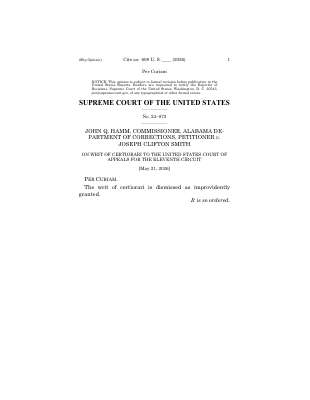
Joseph Smith has been on Alabama's death row for over two decades, and the constitutional question the Supreme Court took up is whether he qualifies as intellectually disabled under Atkins v. Virginia, which bars executing someone with an intellectual disability. The dispute turned on five IQ tests that produced scores ranging from 72 to 78, and Alabama wanted the courts to apply those numbers in a way that put Smith just above the legal threshold rather than look at the full picture. The Supreme Court dismissed the case as improvidently granted in May 2026, leaving the Eleventh Circuit's ruling intact: Smith is intellectually disabled and cannot be executed, though four justices dissented sharply.
Decision
BrynoDC Coverage 1 video
Opinion of the Court
The Facts
Joseph Clifton Smith, a death row inmate in Alabama, scored five IQ tests at 78, 75, 74, 74, and 72, each with a standard error of measurement of plus or minus 3 points. Alabama requires an IQ above 70 to be eligible for capital punishment under Atkins v. Virginia. Smith argued that his scores, when the margin of error is applied, could fall at or below 70, potentially disqualifying him from execution. The state courts upheld his death sentence, and the Supreme Court took the case to address the standard for evaluating intellectual disability claims.
The Issue
Whether a defendant with IQ scores near the intellectual disability threshold must be considered intellectually disabled when the standard error of measurement on each test could place the true score at or below 70.
Smith argued that every one of his IQ scores, accounting for the standard error of measurement, could be 70 or below, making him ineligible for execution under Atkins v. Virginia. Alabama argued its statutory threshold of 70 provides a clear rule, and that courts are not required to adjust raw scores by the standard error of measurement.
The Rules
The Eighth Amendment prohibits executing persons with intellectual disability. States retain discretion in defining intellectual disability, but the clinical standards matter.
States may not use a strict IQ cutoff of 70 without accounting for the standard error of measurement inherent in IQ testing. A rigid cutoff "disregards established medical practice."
Alabama requires an IQ of more than 70 to satisfy intellectual functioning requirements necessary for capital punishment eligibility.
The Application
The Atkins line of cases draws a constitutional floor: the Eighth Amendment bars executing intellectually disabled defendants. But Atkins left it to the states to define intellectual disability. Some states, including Alabama, set a hard IQ cutoff at 70. The Supreme Court pushed back in Hall v. Florida, holding that a rigid cutoff ignores the standard error of measurement built into every IQ test.
Smith's case puts that principle to work with unusually clear numbers. His five IQ scores cluster between 72 and 78. Every single one, when adjusted for the standard error, could fall at or below 70. The question is whether a court must account for that uncertainty or can simply take the raw score at face value.
Alabama's position was that its statute sets a clear rule: above 70 means eligible for execution. The state argued that requiring courts to evaluate every score through the lens of standard error would create endless litigation and uncertainty. Smith's team pointed to Hall v. Florida as dispositive: the Supreme Court already said rigid cutoffs are unconstitutional. The harder question is how much weight courts must give to multiple scores, and whether a pattern of borderline scores across five tests means something different than a single borderline result.
The clinical consensus is that IQ testing always involves measurement error. A score of 72 does not mean a person's true intellectual capacity is exactly 72. It means the true score likely falls within a range, and the bottom of that range for a score of 72 is 69. When all five tests produce scores that could be at or below 70, the cumulative picture is harder for a state to dismiss.
This case matters beyond Alabama. Multiple states still apply strict or near-strict IQ cutoffs despite Hall. A clear ruling on how to evaluate multiple borderline IQ scores would set the standard for every death penalty state with a numerical threshold. The Court's decision determines whether states can execute defendants whose measured IQ scores are consistently in the range where intellectual disability cannot be ruled out.
The broader question is how much clinical precision the Constitution demands. Atkins said no to executing intellectually disabled defendants. Hall said IQ tests are not precise enough for rigid cutoffs. Smith asks the next question: when every test says a person might be intellectually disabled, does that mean they are?
The Conclusion
**The Supreme Court held on the question presented in Hamm v.** Smith. The decision clarifies the law on this issue.
The judgment was rendered accordingly.
No circuit court data for this case.
Flag an issue
This tracker is maintained by BrynoDC and is free because readers fund it. Support