
Hencely v. Fluor Corporation
Case Overview
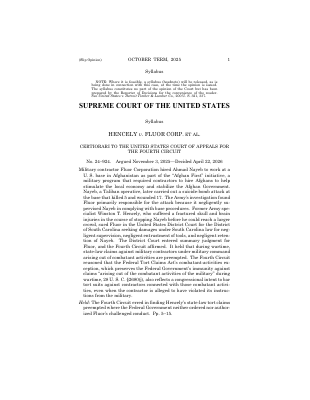
The Supreme Court held, 6-3 in an opinion by Justice Thomas, that the federal contractor defense does not shield a private contractor from state tort liability when the federal government neither ordered nor specifically authorized the conduct that caused the alleged injury. The Court vacated the Fourth Circuit's preemption ruling and remanded for further proceedings.
Decision
BrynoDC Coverage 2 videos
Opinion of the Court
The Facts
Fluor Corporation, a military contractor, hired Ahmad Nayeb to work at a U.S. base in Afghanistan as part of the 'Afghan First' program, which required contractors to hire Afghans. Nayeb was a Taliban operative. He carried out a suicide bomb attack that killed 5 soldiers and wounded 17, including Winston T. Hencely, who suffered a fractured skull and brain injuries. The Army investigation found Fluor primarily responsible for negligently supervising Nayeb. Hencely sued Fluor for negligent hiring and supervision under Wyoming tort law.
The Issue
Whether a military contractor's state-law tort liability for negligent supervision is preempted by federal law, even when the Federal Government did not authorize or order the contractor's negligent conduct.
Fluor argued that allowing state tort suits over hiring and supervision of Afghan workers would interfere with federal military contracting decisions and the government's Afghan First policy. Hencely argued that absent express federal authorization or instruction to act negligently, state tort law applies to contractors like any other employer.
The Rules
State law yields only when it conflicts with rights or restrictions that stem from the Constitution, a valid federal statute, or a treaty. Express preemption requires clear Congressional intent, not contractor inference or convenience.
Preemption occurs when state law conflicts with federal policy expressed in the Constitution or federal statute. A contractor's tort liability does not conflict with federal policy unless the federal government ordered or authorized the tortious conduct.
Military contractors remain liable under state tort law for negligent hiring, retention, and supervision of workers, unless the federal government expressly authorized the negligent conduct as part of the military mission.
The Application
Military contractors are not federal agencies. They are private companies hired by the government to perform services. When a contractor hires a worker, that decision is the contractor's responsibility, not automatically blessed by the military. The Afghan First program told contractors to hire Afghans—it did not tell them to hire Taliban operatives or to negligently supervise them. When Fluor failed to vet Nayeb or monitor him, that failure was Fluor's negligence, not federal policy. The government can authorize risky conduct, but it has to be clear about it.
Preemption requires a conflict between state law and federal policy. Here, there is no conflict. Federal military policy does not include negligent hiring or supervision. In fact, the government's interests are aligned with state tort law: contractors should vet and supervise workers carefully. Allowing state tort suits does not interfere with the Afghan First program. It just holds contractors accountable for how they implement it. If the military wants to shield contractors from liability for particular decisions, Congress can say so. Until then, state tort law applies.
The Conclusion
**The Supreme Court held that the Fourth Circuit erred in finding Hencely's state-law tort claims preempted.** The Federal Government did not order or authorize Fluor's negligent supervision of Ahmad Nayeb. State tort law applies to contractors' hiring and supervision decisions. Hencely's negligent supervision claim can proceed. The judgment was reversed and remanded for trial.
The decision protects injured parties' state-law remedies against military contractors. Contractors are not immune from tort liability simply because they work for the government. They must still meet basic standards of care in hiring and supervision.
No circuit court data for this case.
Flag an issue
This tracker is maintained by BrynoDC and is free because readers fund it. Support