
Hikma Pharmaceuticals USA Inc. v. Amarin Pharma, Inc.
Case Overview
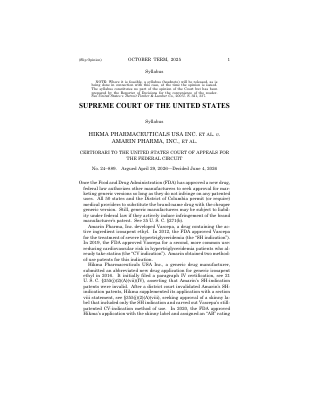
Decided June 4, 2026. The Supreme Court held that Amarin failed to state a claim for actively inducing infringement of its brand-name drug's patented uses under 35 U.S.C. 271(b); the complaint cannot withstand Hikma's motion to dismiss.
Decision
Opinion of the Court
The Facts
Vascepa is a brand-name medication patented by Amarin Pharma to reduce cardiac and stroke risk in people with high triglycerides (around 150 mg/dL). Hikma Pharmaceuticals sells the exact same chemical compound as a generic, but for a different FDA-approved purpose: treating even higher triglyceride levels (500 mg/dL). Hikma's generic drug labels carefully carve out the patented use and make no mention of it. But a press release from Hikma called its product a "generic version" of Vascepa and cited public sales data about the branded drug. Amarin sued for induced patent infringement, arguing that Hikma was encouraging doctors to prescribe the generic for the patented use.
The Issue
Whether a generic drugmaker can be liable for induced infringement of a patented method-of-treatment when its drug label carves out the patented use entirely, but the company issued a press release calling its product a "generic version" and citing sales data about the branded drug.
Amarin argued that Hikma's press release, combined with doctors' existing knowledge of Vascepa's patented use, was enough to show Hikma intended to induce infringement. Hikma argued that its label says nothing about the patented use, and that calling a product a "generic version" and citing publicly available sales data is not an instruction or encouragement to use the drug for a patented purpose.
The Rules
"Whoever actively induces infringement of a patent shall be liable as an infringer." Requires proof that the defendant knowingly induced another to infringe, not merely that infringement occurred.
Generic manufacturers may carve out patented uses from their FDA-approved labels, allowing them to sell the same compound for non-patented indications without infringing.
Induced infringement requires proof that the defendant knew the induced acts constitute patent infringement or was willfully blind to that fact.
The Application
The Hatch-Waxman Act created a careful balance in pharmaceutical patent law. Generic drug companies can sell the same chemical compound as a brand-name drug, but they must carve out any patented uses from their labels. If the brand holds a patent on using Drug X for heart disease, the generic can sell Drug X for a different condition, and its label must say nothing about the patented heart disease use.
Hikma followed this framework. Its label carved out the patented use entirely. A doctor looking at Hikma's label would find no mention of reducing cardiac risk in patients with moderate triglycerides. The question is whether marketing materials outside the label can undo that careful carve-out.
Amarin's theory rests on Hikma's press release. By calling its product a "generic version" of Vascepa and citing Vascepa's sales data, Hikma arguably signaled to the market that its drug does the same thing Vascepa does, including the patented use. Doctors who already know about Vascepa's cardiac benefits might prescribe Hikma's generic for that purpose, even though Hikma's label does not mention it.
Hikma's defense is that calling something a "generic version" is a factual statement -- it is the same chemical -- and citing public sales data is not an instruction to use the drug for any particular purpose. Induced infringement requires active encouragement to infringe, not merely making a product available that someone might misuse. If a press release that states publicly available facts is enough to trigger inducement liability, the entire generic drug carve-out system is at risk.
This case matters for every generic drug that shares a compound with a patented brand-name medication. The Hatch-Waxman carve-out system depends on generic companies being able to sell approved drugs without worrying that any reference to the brand will be treated as inducing infringement of the brand's patents.
If the Court rules that a press release calling a drug a "generic version" is enough to plead inducement, generic companies will face litigation risk every time they market their products in relation to the brand-name equivalent. That would chill generic competition and undermine the purpose of the Hatch-Waxman Act, which was to make cheaper drugs available to patients. If the Court rules that label carve-outs are sufficient and marketing statements about public facts are not inducement, it protects the generic drug market but potentially limits brand-name patent holders' ability to enforce method patents.
The Conclusion
**The case tests whether a generic drugmaker that properly carves out a patented use from its label can still face inducement liability based on a press release calling the product a "generic version" of the branded drug.**
The answer will define how much generic companies can say about their products without crossing the line from factual description into induced infringement. The Hatch-Waxman carve-out system hangs in the balance.
No circuit court data for this case.
Flag an issue
This tracker is maintained by BrynoDC and is free because readers fund it. Support