
Jules v. Andre Balazs Properties
Case Overview
This case does not appear in the provided transcript.
BrynoDC Coverage 1 video
The Facts
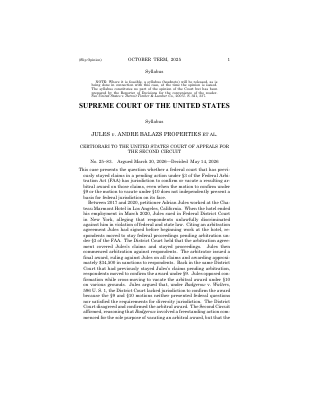
Adrian Jules, a hotel employee, lost an employment discrimination claim in arbitration. The arbitrator ruled in favor of his employer, Andre Balazs Properties. Jules sought to challenge the arbitration award, but ran into a jurisdictional problem: the Federal Arbitration Act's provisions for confirming and vacating arbitration awards (Sections 9 and 10) may not independently create federal court jurisdiction. Unlike other parts of the FAA, these sections lack the specific language courts typically require to establish subject-matter jurisdiction.
The Issue
Whether Sections 9 and 10 of the Federal Arbitration Act independently create federal subject-matter jurisdiction to confirm or vacate an arbitration award, or whether a party must establish some other basis for federal jurisdiction.
Jules argued that the FAA's provisions for judicial review of arbitration awards should carry their own jurisdictional grant, since arbitration is a creature of federal law. The employer argued that Sections 9 and 10 lack the "magic words" that exist elsewhere in the FAA and in other federal statutes that expressly confer jurisdiction, and that a separate jurisdictional basis (such as diversity) is required.
The Rules
Provides that a court "must grant" confirmation of an arbitration award when a party applies, but does not contain explicit jurisdictional language.
Permits a court to vacate an arbitration award on narrow grounds (corruption, evident partiality, exceeding authority), but likewise lacks express jurisdictional language.
The Court held that FAA §4 does not itself create federal jurisdiction to compel arbitration — a court must 'look through' the §4 petition to the underlying dispute to find an independent jurisdictional basis.
Held that Vaden's look-through doctrine does not extend to §§9–10 petitions to confirm or vacate an award. A court cannot look through the FAA motion to the underlying dispute — jurisdiction must appear on the face of the application itself.
The Application
The Federal Arbitration Act is one of the most powerful statutes in American employment law. It forces millions of disputes into arbitration. But when the arbitration is over and a party wants a court to review the result, the FAA may not give them a federal courtroom to do it in.
The problem is textual. Some parts of the FAA explicitly reference federal court jurisdiction. Sections 9 and 10 -- the provisions for confirming and challenging awards -- do not. They say a court "must grant" confirmation or "may" vacate, but they do not say "the district court shall have jurisdiction." In statutory interpretation, that silence can be fatal.
This creates an odd gap in the system. The FAA compels arbitration in federal court (Section 4 has been read to allow compelling arbitration where jurisdiction otherwise exists). But after the arbitration is done and a party wants the result enforced or overturned, they may need to go to state court or find another jurisdictional hook -- diversity of citizenship, a federal question in the underlying dispute, or some other basis.
For employees like Jules, this matters. An employment discrimination claim might start in federal court, get sent to arbitration under the FAA, and then the losing party cannot get back into federal court to challenge the result. The arbitration clause that pulled the case out of court also, effectively, locked the courthouse door on the way out.
The case has implications well beyond employment law. Every commercial arbitration governed by the FAA runs through Sections 9 and 10 for enforcement and challenges. If those provisions do not independently create jurisdiction, then countless arbitration award disputes must be routed through state courts or justified on independent federal grounds. That changes the calculus for parties choosing where and how to arbitrate.
The deeper question is whether the FAA's structure is coherent. Congress wrote a statute that dominates American dispute resolution but may not have given federal courts the power to police the results. If the Court holds that Sections 9 and 10 lack jurisdictional force, it confirms that the FAA is primarily a substantive rule that state and federal courts alike can apply -- not a federal jurisdictional statute.
The Conclusion
**The Supreme Court held, in an opinion by Justice Sotomayor, that a federal court that has previously stayed claims under §3 of the Federal Arbitration Act retains jurisdiction to confirm or vacate the resulting arbitral award under §§9 and 10.** The Court rejected the argument that §§9 and 10 require an independent jurisdictional basis separate from the §3 stay proceeding. Once a court exercises jurisdiction to stay claims pending arbitration, that jurisdiction carries through to post-award review.
No circuit court data for this case.
Flag an issue
This tracker is maintained by BrynoDC and is free because readers fund it. Support