
Keathley v. Buddy Ayers Construction, Inc.
Case Overview
The case concerns judicial estoppel in the bankruptcy context, where the debtor failed to update bankruptcy forms to disclose a personal injury claim, and the Fifth Circuit applied a conclusive presumption that the omission was intentional based on the debtor's knowledge of the facts and potential motive. The case is at the U.S. Supreme Court on certiorari, and the argument focused on whether the Fifth Circuit's test is too rigid and whether courts must conduct a holistic analysis of the debtor's actual intent before applying judicial estoppel. No final ruling is issued in the transcript, but the Court heard oral arguments and the case is submitted.
Decision
9-0BrynoDC Coverage 2 videos
Opinion of the Court
The Facts
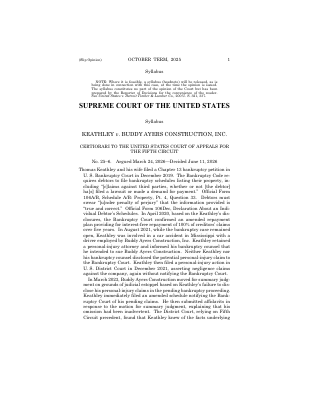
Thomas Keathley and his wife filed a Chapter 13 bankruptcy petition in the Eastern District of Arkansas in December 2019. In April 2020, the court confirmed a repayment plan requiring interest-free repayment of 100% of creditors' claims over five years. In August 2021, while the bankruptcy remained open, Keathley was hit in a car accident in Mississippi with a driver employed by Buddy Ayers Construction. He retained a personal-injury attorney and told his bankruptcy counsel about the potential claim. Neither attorney disclosed it to the Bankruptcy Court. Keathley filed a personal-injury action in the Northern District of Mississippi in December 2021. When Buddy Ayers moved for summary judgment on judicial estoppel grounds in March 2023, Keathley immediately amended his bankruptcy schedules and submitted affidavits explaining the omission was inadvertent. His bankruptcy counsel attested that Keathley received no monetary benefit from the nondisclosure.
The Issue
Whether the Fifth Circuit's two-factor test for determining inadvertence or mistake in the judicial estoppel context - which looks only at (1) whether the debtor knew the underlying facts and (2) whether there was a hypothetical motive to conceal - is consistent with equitable principles that require courts to consider the totality of the circumstances.
The Rules
Judicial estoppel is an equitable doctrine intended "to protect the integrity of the judicial process" by "prohibiting parties from deliberately changing positions according to the exigencies of the moment" and preventing "the risk of inconsistent court determinations." It may be inapposite where the inconsistent position was the result of "inadvertence or mistake."
Equity "eschews mechanical rules; it depends on flexibility." When a court conducts an equitable inquiry, it must act "on a case-by-case basis," considering all relevant facts and circumstances.
When a debtor files for bankruptcy, a bankruptcy estate is created comprising "all legal or equitable interests of the debtor in property as of the commencement" of the case, including pending and unliquidated claims against third parties.
Debtors must disclose all "claims against third parties, whether or not the debtor has filed a lawsuit or made a demand for payment." Debtors must swear, under penalty of perjury, that the information is "true and correct."
The Application
Judicial estoppel prevents a party from taking one position in court and then switching to the opposite position in a later proceeding. The classic scenario: you tell one judge X is true, benefit from that position, and then tell a different judge X is false. Courts developed the doctrine to stop people from gaming the system.
In the bankruptcy context, lower courts have extended this idea. If you file for bankruptcy and swear under oath that you have no pending claims against anyone, but then turn around and file a lawsuit asserting exactly that kind of claim, you have arguably taken inconsistent positions in two different courts. Some circuits treat the failure to disclose as an "implicit representation" that no claim exists, and then bar the lawsuit under judicial estoppel.
The escape hatch, recognized by most circuits, is that judicial estoppel should not apply when the inconsistency was the result of inadvertence or mistake. The question in Keathley was how courts should determine whether an omission was truly inadvertent.
The Fifth Circuit's test allowed courts to consider only two things: whether the debtor knew the facts underlying the claim, and whether there was a hypothetical motive to conceal it. If both were present, the omission was deemed intentional as a matter of law, regardless of any other evidence.
The Supreme Court said that test was both too rigid and too broad. Too rigid because it locked courts into considering only two factors when equity demands flexibility and a holistic inquiry. Too broad because it treated nearly every bankruptcy omission as intentional: debtors almost always know about their own claims, and there is almost always a hypothetical financial benefit to nondisclosure. A test that is satisfied in virtually every case is not really a test at all.
The Court held that courts must look at the totality of the circumstances, including evidence like Keathley's affidavits explaining the omission, his bankruptcy counsel's attestation that there was no monetary benefit, and the common practice in his district of amending schedules before settlement.
The Fifth Circuit's rule is not only too rigid, it is also too broad. The court held that an omission falls outside the inadvertence exception any time a debtor knows certain facts or could potentially benefit from nondisclosure. But it is rare for a debtor to be unaware of the underlying facts of his claim, and a debtor will almost always hypothetically benefit from not revealing a claim to creditors. A test that is satisfied in virtually every case is not really a test at all. As the Fifth Circuit itself acknowledged, the potential-motive element "is almost always met if a debtor fails to disclose a claim or possible claim to the bankruptcy court." The Court vacated and remanded for a totality-of-the-circumstances analysis.
The Conclusion
**When determining whether a bankruptcy omission was inadvertent or mistaken for purposes of judicial estoppel, courts must examine the totality of the circumstances.** The Fifth Circuit's two-factor test, which looked only at the debtor's knowledge and hypothetical motive, was too rigid to qualify as a genuine equitable inquiry and too broad to meaningfully distinguish intentional concealment from honest mistakes. Vacated and remanded for a holistic analysis.
Judicial Philosophy and the Future of Equity
The concurrences in this case reveal a deeper debate about what equity is, where it comes from, and how far judges can take it.
Concurrence — Thomas, J. (joined by Gorsuch, J.)
Justice Thomas joined the majority opinion in full but wrote separately to question whether judicial estoppel should exist as a federal doctrine at all. He traced the doctrine to a single 1857 Tennessee state court decision and noted that a century later it was still "the minority viewpoint which has encountered inhospitable reception outside the State of Tennessee." It only entered the federal mainstream in recent decades, with lower courts applying it "broadly without clear authority" from the Supreme Court.
Thomas identified a fundamental problem: it is unclear what gives federal courts the authority to bar lawsuits based on judicial estoppel. The doctrine has no basis in any statute, any Federal Rule of Civil Procedure, or any traditional inherent power of federal courts. Although courts often assume it arises from their "general equitable authority," Thomas cited Trump v. CASA, Inc. (2025) for the principle that "equitable authority is not free-wheeling" and requires "a founding-era antecedent." Judicial estoppel appears to lack one.
Thomas also noted that the Supreme Court has apparently enforced judicial estoppel only a single time, in New Hampshire v. Maine (2001), an original-jurisdiction case that did not resemble how lower courts now apply the doctrine. He concluded: "Judicial estoppel has secured widespread acceptance in the Courts of Appeals without any clear authority in statutes, rules of procedure, or this Court's precedents. In a future case, this doctrine merits a closer look."
Concurrence — Sotomayor, J.
Justice Sotomayor agreed that the Fifth Circuit's test was erroneous but wrote separately to argue that judicial estoppel may never make sense in the bankruptcy context when proceedings are still pending. Her concern was practical: applying judicial estoppel to bar a debtor's personal-injury lawsuit actually hurts the creditors it claims to protect.
Sotomayor pointed out the perverse incentives. When the courts below barred Keathley's tort claim, they "vaporized assets that could have been used for the creditors' benefit" and gave the employer of the alleged tortfeasor a windfall, even though Buddy Ayers was not involved in the bankruptcy and was not harmed by the delayed disclosure. The party most likely to benefit from judicial estoppel in this context is the defendant in the separate proceeding, someone who is not prejudiced by the debtor's earlier inconsistent position but whom judicial estoppel permits to escape liability.
Sotomayor also emphasized that bankruptcy courts already have better tools for dealing with nondisclosure. They can impose sanctions, modify the repayment plan, revoke an order of confirmation, decline to discharge the debtor, fine the debtor, convert the case from Chapter 13 to Chapter 7, or refer the debtor to the U.S. Attorney for potential perjury. All of these remedies address the misconduct directly without the collateral damage of killing a legitimate tort claim. As she put it: "Judicial estoppel provides one remedy and one remedy only: dismissal of the tort claim. Given that bankruptcy courts can craft full remedies to alleviate any prejudice to creditors caused by a belated disclosure of a claim, it is difficult to see how using judicial estoppel to bar the debtor from pursuing a separate claim, which only harms creditors, is either needed or warranted."
No circuit court data for this case.
Flag an issue
This tracker is maintained by BrynoDC and is free because readers fund it. Support