
Monsanto Company v. Durnell
Decision
7-2BrynoDC Coverage 2 videos
Opinion of the Court
The Facts
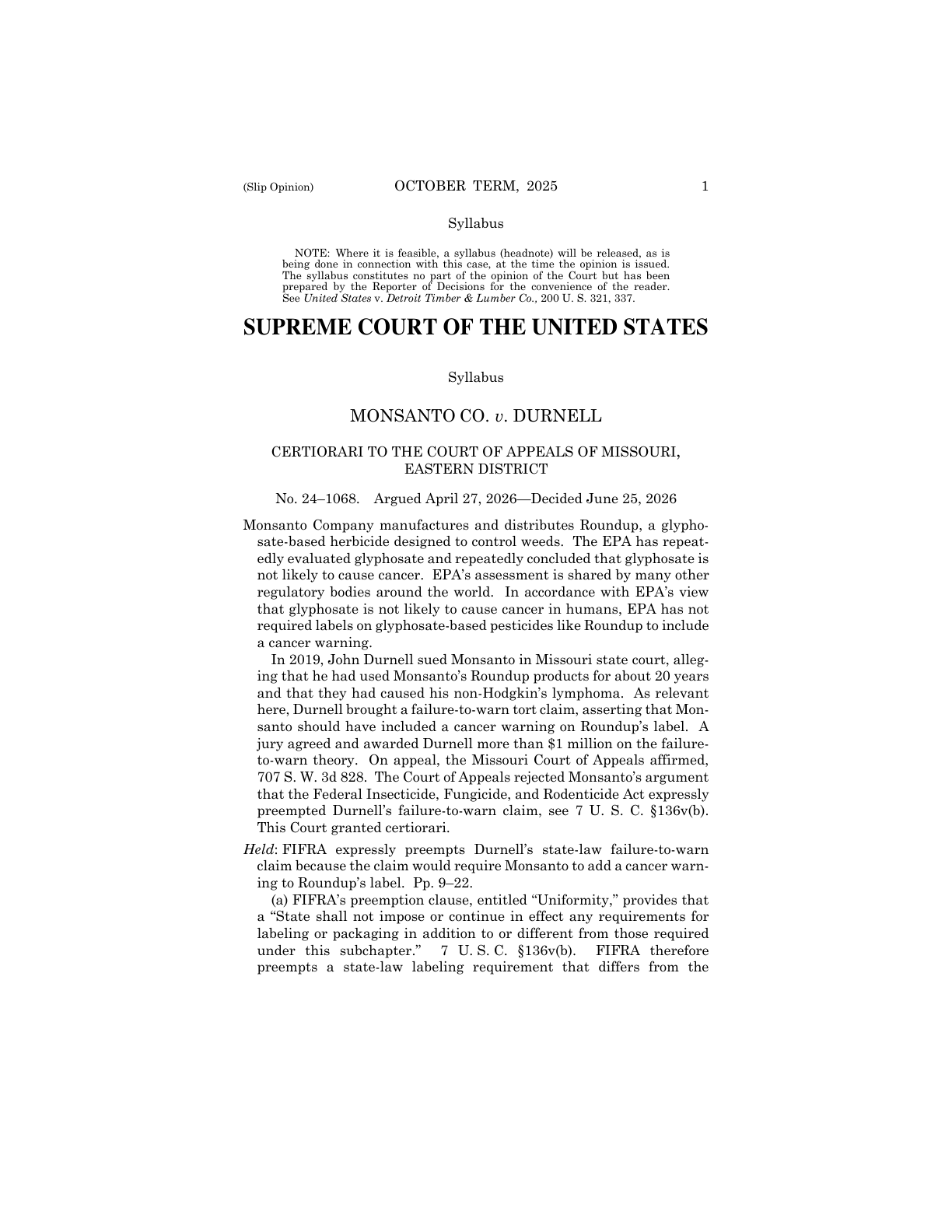
John Durnell alleges that regular use of Monsanto's Roundup herbicide (glyphosate-based) caused him to develop non-Hodgkin's lymphoma, and he brought a state-law failure-to-warn claim. Monsanto argues that because the EPA approved the product's label and found glyphosate is not likely carcinogenic, FIFRA preempts any state-law claim requiring a different or additional cancer warning. Multiple circuits have split on whether FIFRA preempts such claims.
The Issue
Whether the Federal Insecticide, Fungicide, and Rodenticide Act (FIFRA), 7 U.S.C. § 136v(b), preempts state-law failure-to-warn claims when the EPA has approved the pesticide's label and not required a warning about the alleged harm.
The Rules
Such state shall not impose or continue in effect any requirements for labeling or packaging in addition to or different from those required under this subchapter.
FIFRA preempts state labeling requirements only if they are 'in addition to or different from' FIFRA requirements; state tort failure-to-warn claims may survive if they parallel federal requirements.
The Application
Monsanto argues FIFRA § 136v(b) expressly preempts state-law failure-to-warn claims when the EPA has reviewed and approved a pesticide's labeling. Requiring different or additional warnings under state law creates conflicting obligations Congress intended to prevent. The EPA's determination that glyphosate is 'not likely to be carcinogenic' should control.
Durnell argues FIFRA does not preempt state tort claims that are parallel to federal requirements. State juries may find that a manufacturer knew of dangers the EPA did not consider. Under Bates v. Dow Agrosciences (2005), state claims that do not require labeling different from federal law survive preemption.
Argued April 27, 2026. Thousands of Roundup cancer lawsuits with billions in verdicts and settlements hang on this ruling. If FIFRA preempts state failure-to-warn claims, it could effectively immunize pesticide manufacturers from state tort liability whenever the EPA has approved their labels — fundamentally reshaping product liability law.
The Conclusion
FIFRA expressly preempts Durnell's state-law failure-to-warn claim. Writing for a 7-2 Court, Justice Kavanaugh held that because EPA approved Roundup's label without a cancer warning and legally requires Monsanto to use that label, a state tort duty to add a cancer warning is "in addition to or different from" federal requirements and is preempted by FIFRA §136v(b). Reversed and remanded. Thomas concurs. Jackson joined by Gorsuch dissents.
No circuit court data for this case.
Flag an issue
This tracker is maintained by BrynoDC and is free because readers fund it. Support