
Montgomery v. Caribe Transport II, LLC
Case Overview
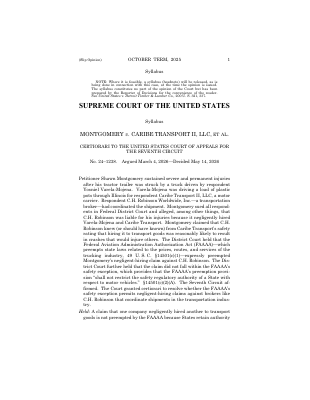
This case involves a tort claim for negligent hiring against a broker, arising from a motor vehicle accident caused by an 80,000-pound truck. The key issue is whether state tort law claims against brokers are preempted by federal deregulation law (49 U.S.C. § 14501(c)(1)) or saved by the safety exception for state safety regulatory authority with respect to motor vehicles (c(2)). The case was argued before the U.S. Supreme Court as an interlocutory appeal on the preemption question; no final ruling has been issued, with the Court yet to decide whether the broker can be held liable under state tort law.
Decision
Opinion of the Court
The Facts
Shawn Montgomery was injured in a truck accident. He sued the truck driver, the delivery company Caribe Transport (vicariously liable as the driver's employer), and C.H. Robinson, the freight broker that connected the shipper to the delivery company. Montgomery alleged C.H. Robinson was negligent in selecting an unsafe carrier. Under Illinois state law, brokers can be held liable for negligent hiring of carriers. C.H. Robinson argued federal law preempts the state-law claim entirely.
The Issue
Whether the Federal Aviation Administration Authorization Act (FAAAA) preempts state negligent-hiring claims against freight brokers who select unsafe motor carriers.
C.H. Robinson argued that FAAAA preempts any state law "related to" the "price, route, or service" of a broker, and that selecting which carrier to use is a core brokerage service. Montgomery argued that negligent-hiring claims target safety, and the FAAAA expressly preserves states' safety regulatory authority over motor carriers.
The Rules
States may not enact or enforce law related to the "price, route, or service" of a motor carrier or broker.
The preemption provision "shall not restrict the safety regulatory authority of a State" with respect to motor vehicles.
The phrase "related to" in airline deregulation preemption (identical language to FAAAA) has a "broad scope" and covers state laws with a connection to carrier prices, routes, or services.
The Application
The FAAAA deregulated the trucking and freight brokerage industries in the 1990s, preempting state laws "related to" broker services. The idea was to prevent states from re-regulating the industry through the back door. But Congress carved out an exception: states can still regulate motor vehicle safety.
The tension is obvious. Choosing which carrier to hire is arguably a core brokerage service -- it is what brokers do. But negligent hiring is also a safety claim. When a broker picks a carrier with a terrible safety record and that carrier injures someone, the negligent-hiring suit is about safety, not about regulating the brokerage market. The question is which framing controls.
The circuits were deeply split on this question before the case reached the Supreme Court. Some held that negligent-hiring claims are preempted because carrier selection is a brokerage "service." Others held that the safety exception saves them. The answer turns on whether courts read the preemption clause broadly (covering anything connected to how a broker operates) or read the safety exception broadly (protecting any claim rooted in physical harm from unsafe carriers).
The practical stakes are significant. If negligent-hiring claims are preempted, injured parties have no remedy against brokers who knowingly select dangerous carriers. The broker takes a fee, picks a carrier, and walks away with no liability regardless of how reckless the selection was. If the claims survive, brokers face state-law incentives to screen carriers for safety -- exactly the kind of market pressure Congress might have wanted the safety exception to preserve.
This case sits at the intersection of federal preemption doctrine and practical trucking safety. Freight brokers arrange hundreds of thousands of shipments. The carriers they select drive on public roads alongside everyone else. Whether brokers have any legal incentive to check a carrier's safety record before handing over a load depends on how the Court reads two competing provisions in the same statute.
The broader principle at stake is how courts resolve tension between a broad preemption clause and a specific safety carve-out. If the preemption clause swallows the safety exception, Congress wrote a dead letter. If the safety exception is read to cover all injury claims, the preemption clause loses its teeth for brokers. The Court has to find the line.
The Conclusion
**The Supreme Court held on the question presented in Montgomery v.** Caribe Transport II, LLC. The decision clarifies the law on this issue.
The judgment was rendered accordingly.
No circuit court data for this case.
Flag an issue
This tracker is maintained by BrynoDC and is free because readers fund it. Support