
Noem v. Al Otro Lado
Case Overview
During the Biden administration, the government adopted a practice of 'metering' — limiting how many asylum seekers could present themselves at ports of entry each day and turning away the rest. People who were turned away and returned to Mexico sued, arguing they had a right under the asylum statute to claim protection at the border. The case turns on what 'arrives in the United States' means in the asylum law — whether turning up at a port of entry counts, or whether you have to physically cross into U.S. territory first. The government is expected to win 6-3 or 5-4. Bryan covers it as a case that will determine what access to the asylum process actually looks like going forward.
Decision
6-3BrynoDC Coverage 4 videos
Opinion of the Court
The Facts
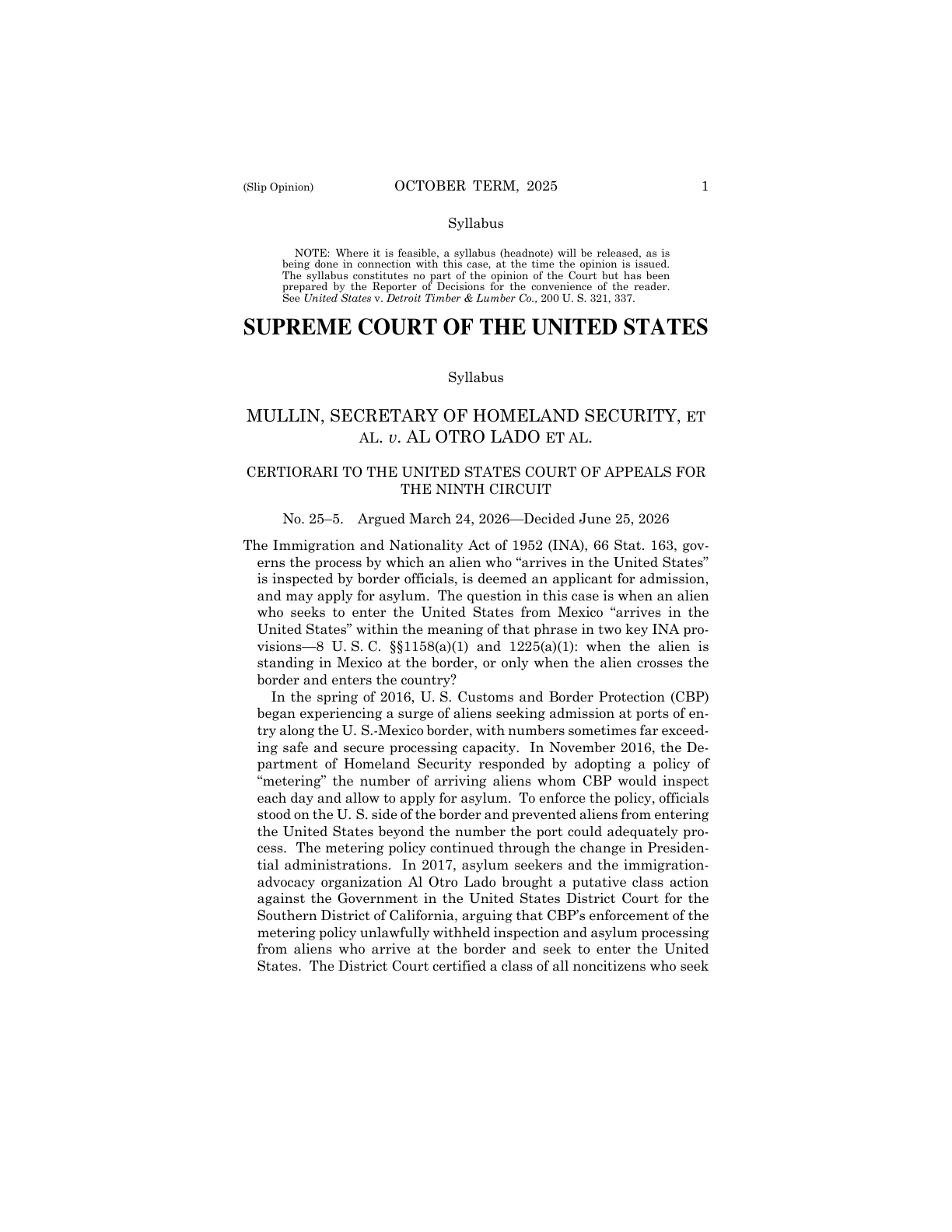
During the Biden administration, border officials adopted 'metering' — limiting the number of asylum seekers permitted to present at ports of entry each day and turning back the rest to wait in Mexico. Migrants who were turned away sued, arguing that the Immigration and Nationality Act gives them a statutory right to present themselves at any port of entry to request asylum, and that metering violated that right. The question is whether the INA creates such a right and whether the government's informal practice was lawful.
The Issue
Whether 8 U.S.C. § 1225 gives asylum seekers a statutory right to present themselves at a port of entry that the government cannot limit through informal metering policies; and whether plaintiffs have a cognizable cause of action to challenge the practice.
The Rules
All aliens seeking admission or readmission to the United States shall be inspected; applicants for admission must be referred to an asylum officer or immigration judge.
Any alien who is physically present in the United States or who arrives in the United States, irrespective of such alien's status, may apply for asylum.
A reviewing court shall hold unlawful and set aside agency action found to be arbitrary, capricious, an abuse of discretion, or otherwise not in accordance with law.
The Application
The government argues DHS has broad operational authority to manage border processing, including limiting when and how asylum seekers can present claims at ports of entry. Port closures and the terminated CBP One app are exercises of executive discretion over immigration enforcement, not violations of the INA's asylum provisions.
Respondents argue INA § 208(a)(1) creates a mandatory right — any person who 'arrives in the United States' may apply for asylum. Congress spoke directly: the executive cannot nullify a statutory right through administrative fiat. Closing ports of entry to asylum seekers effectively amends a comprehensive statutory scheme without congressional authorization.
Argued March 24, 2026. The case tests whether the executive can shut off asylum processing by administrative action alone. Conservative Justices have generally given wide latitude on border management, but the INA's mandatory language is unusually direct. A ruling for the government could validate complete asylum shutdowns at ports of entry. Gorsuch's textualism could produce an unusual coalition.
The Conclusion
An alien standing in Mexico who attempts but fails to enter the United States does not "arrive in the United States" for INA purposes. Alito, 6-3. The INA neither entitles such aliens to apply for asylum nor requires immigration officers to inspect them. The Ninth Circuit's declaratory judgment was reversed and remanded. Thomas concurs. Sotomayor (joined by Kagan and Jackson) dissents. Jackson dissents separately.
No circuit court data for this case.
Flag an issue
This tracker is maintained by BrynoDC and is free because readers fund it. Support