
Rico v. United States
Decision
BrynoDC Coverage 8 videos
Opinion of the Court
The Facts
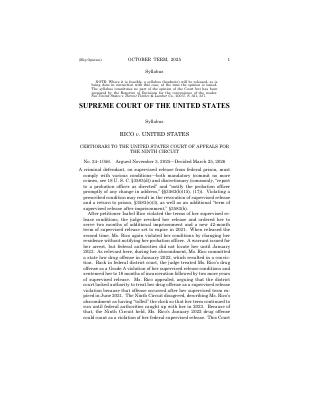
Isabel Rico pleaded guilty to federal drug trafficking in 2010 and was sentenced to seven years in prison followed by supervised release. After an early violation, she was sent back to prison and given a new 42-month supervised release term set to expire in June 2021. But shortly after her second release, she disappeared. She changed her address without telling her probation officer and was not found for nearly five years. During that time, she committed new state crimes, including a drug offense in January 2022, seven months after her supervised release was supposed to have ended. The federal court treated that drug offense as a Grade A supervised release violation and sentenced her to 16 more months in prison. She appealed, arguing her supervised release had already expired.
The Issue
Whether a defendant's absconding from supervised release automatically extends (or "tolls") the term of supervised release beyond the court-ordered expiration date, so that offenses committed after that date can still be treated as supervised release violations.
The government argued that a defendant who absconds receives no "credit" for time spent evading supervision, so the clock should stop running until authorities catch up. Rico argued the statute sets a firm expiration date and gives courts other tools to address absconders without inventing an automatic extension rule Congress never wrote.
The Rules
A term of supervised release starts "the day the person is released from imprisonment." This provision also contains a true tolling rule: supervised release "does not run during any period in which the person is imprisoned" for 30+ consecutive days.
Supervised release is generally limited to one, three, or five years depending on the severity of the underlying offense. The Ninth Circuit's automatic extension rule risks pushing terms beyond these statutory maximums.
A court may "extend a term of supervised release" but only after a hearing, considering sentencing factors, and not beyond the statutory maximum or after the term has expired.
A court's power to revoke supervised release "extends beyond the expiration of the term" but only for "matters arising before its expiration" and only if a warrant or summons was issued before the term expired.
If a defendant violates a condition, the court may revoke supervised release, send the defendant back to prison, and impose a new term of supervised release. This is one of the Act's existing tools for addressing absconders.
The Court previously rejected an effort to adorn the Act with a rule Congress did not enact. The same principle applies here: the absence of an automatic extension rule is intentional, not an oversight.
The Application
The first thing Gorsuch does is fix the vocabulary. The Ninth Circuit called its rule "tolling," but tolling means stopping the clock. That is not what was happening. Under the Ninth Circuit's approach, a defendant who absconds does not get the clock paused. She remains bound by all conditions of supervised release and can be punished for any violation committed during the absconding period. The term does not freeze. Instead, the Ninth Circuit's rule extends the period of supervised release beyond whatever a judge ordered, for as long as the defendant remains missing. That is not tolling. That is an automatic extension. And it is nowhere in the statute.
The Sentencing Reform Act gives courts detailed, specific tools for dealing with defendants who fail to report. Courts can revoke supervised release. They can send the defendant back to prison. They can impose a new term of supervised release after reimprisonment. They can even revoke after the term expires, as long as a warrant or summons issued beforehand. Congress thought carefully about these mechanisms, set limits on each one, and said nothing about automatic extension for absconding.
The Act already has a real tolling provision, and it looks nothing like the Ninth Circuit's rule. Section 3624(e) says supervised release pauses when the defendant is imprisoned for 30 or more consecutive days. That is narrow, specific, and judge-independent. The Ninth Circuit's rule, by contrast, is automatic, indefinite, and bypasses every limit Congress placed on extensions: no hearing required, no statutory maximum cap, and no expiration date means anything anymore.
Congress also built in a specific extension mechanism. Section 3583(e)(2) lets a court extend a term of supervised release, but only after holding a hearing, only within statutory maximums, and only before the term has already expired. The Ninth Circuit's automatic extension rule ignores all three constraints. Under its approach, no hearing is needed, the term can extend beyond the statutory maximum, and a court-ordered expiration date becomes meaningless. If Congress wanted absconding to automatically extend supervised release, it would have said so, the way it said so for imprisonment.
The government tried three backup arguments. First, it pointed to statutory provisions requiring "observation and direction" by a probation officer, arguing Rico should get no credit for time she was not actually supervised. But those provisions describe the probation officer's duties, not the length of the term. They actually hurt the government's case, since they say supervision occurs only "during the term imposed" by the court.
Second, the government invoked common-law precedent. For centuries, courts have held that an escaped prisoner's time on the run does not count toward discharge of his sentence. But the Court drew a sharp distinction: stopping the clock on a prison escape is not the same as extending a supervised release term. An escaped prisoner is not serving his sentence. A defendant who fails to report is still bound by release conditions and can still be punished for every violation. The Act already provides courts with plenty of tools to ensure defendants do not profit from absconding.
Finally, the government made a policy plea: without automatic extension, probation officers who do not catch an absconder before the term expires may be left without recourse. Gorsuch's answer was blunt. If the government thinks the warrant-or-summons requirement in Section 3583(i) is too demanding, "the proper place to register that complaint is with those who drafted it." The Court is not free to rewrite the statute.
The Conclusion
**The Sentencing Reform Act does not authorize automatically extending a defendant's term of supervised release when she absconds.** The Ninth Circuit's rule is an adornment Congress never enacted. Reversed and remanded.
Gorsuch's opinion is a clean textualist exercise. Congress gave courts many tools to address absconders but chose not to include automatic extension. The Court will not add it for them.
No circuit court data for this case.
Flag an issue
This tracker is maintained by BrynoDC and is free because readers fund it. Support