
Slaughter v. Trump (Slaughter FTC Removal)
Case Overview
In 1935 the Supreme Court ruled that Congress could shield independent-agency officials from at-will firing — meaning the president can't remove the FTC chair or the NLRB chair just because he wants to. Trump fired FTC Commissioners Rebecca Slaughter and Alvaro Bedoya in March 2025 without cause, openly defying that precedent (Humphrey's Executor), and the Supreme Court took the case. At December 2025 oral argument every signal pointed toward overruling Humphrey's, which would give every future president the power to fire the leadership of the Federal Reserve, the NLRB, and every independent regulatory body on a whim.
Decision
BrynoDC Coverage 2 videos
Opinion of the Court
The Facts
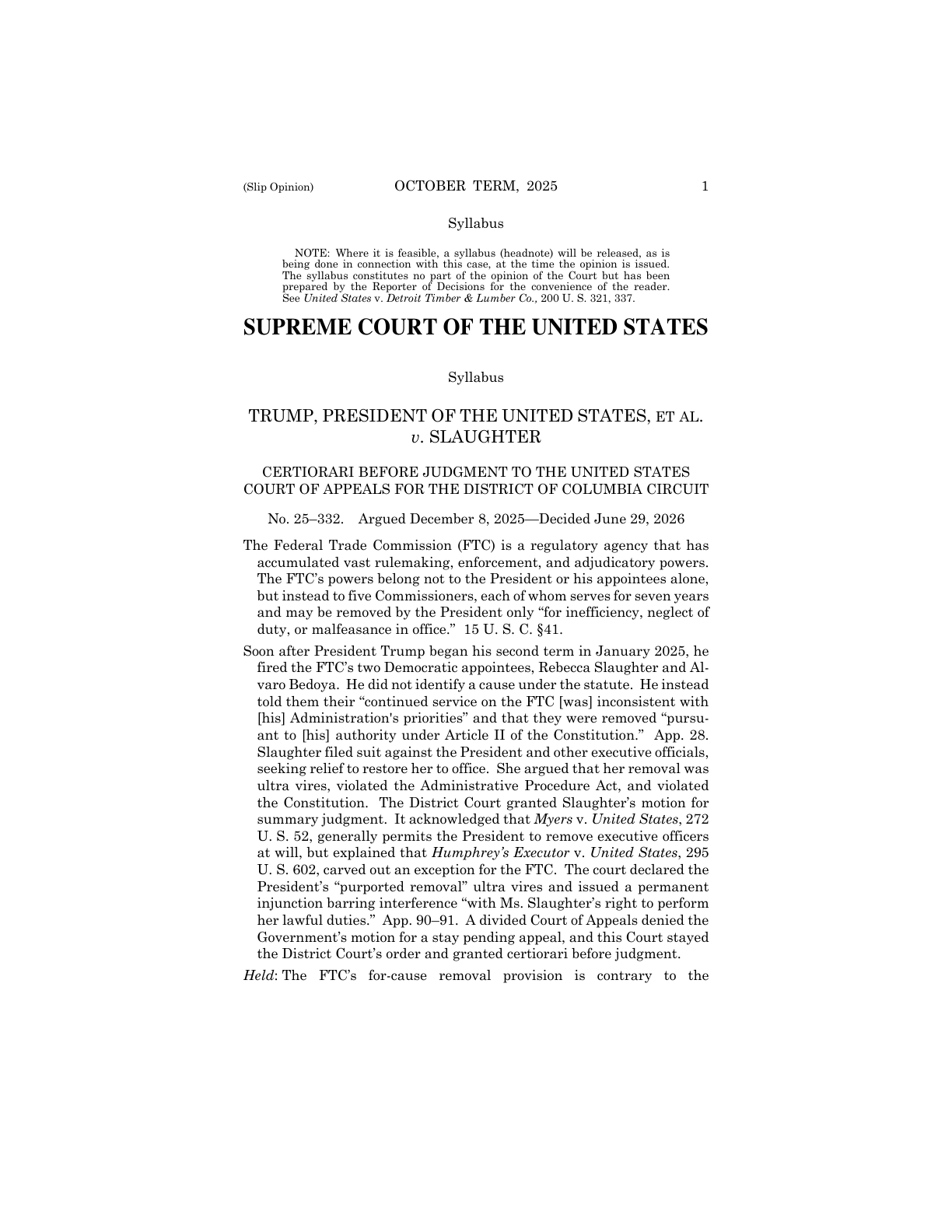
FTC Commissioners Rebecca Kelly Slaughter and Alvaro Bedoya were purportedly fired by President Trump in early 2025. They sued in the U.S. District Court for the District of Columbia, arguing the President cannot remove independent agency commissioners except for "inefficiency, neglect of duty, or malfeasance in office" under the FTC Act — a protection upheld by the Supreme Court in Humphrey's Executor v. United States (1935). The district court sided with the commissioners. The government appealed and simultaneously sought emergency relief from the Supreme Court.
The Issue
Does the President have constitutional authority to remove members of independent regulatory commissions at will, notwithstanding statutory for-cause removal protections?
Should Humphrey's Executor v. United States (1935) be overruled?
The Rules
Congress may limit the President's power to remove officials of independent regulatory agencies to removal only for cause — inefficiency, neglect of duty, or malfeasance in office. The FTC was the agency at issue in the original 1935 case.
"The executive Power shall be vested in a President of the United States of America." The unitary executive theory reads this as granting the President plenary control over all executive officers, including the power to remove them at will.
The Court struck down for-cause removal protections for the CFPB's single director, distinguishing (but not overruling) Humphrey's Executor on the ground that multi-member commissions diffuse power in a way a single director does not.
The Application
Judge Alikhan in the D.D.C. granted summary judgment for Slaughter, finding that under existing precedent the firing was unlawful — Humphrey's Executor remains good law, and the FTC Act's for-cause removal protections apply.
The government argued that Humphrey's Executor should be reconsidered in light of Seila Law v. CFPB (2020) and Collins v. Yellen (2021), which narrowed protections for single-director agencies. The D.C. Circuit appeal (No. 25-5261) proceeded simultaneously with the emergency stay application to the Supreme Court. The Court granted certiorari on an expedited basis in September 2025.
The Supreme Court heard oral arguments on December 8, 2025. The central question: is the FTC's multi-member, for-cause-protected structure constitutionally distinguishable from the single-director agencies struck down in Seila Law? If the Court overrules Humphrey's Executor, every independent agency in the federal government — the SEC, FCC, NLRB, Federal Reserve — loses its structural independence from the White House.
The Conclusion
The Supreme Court ruled 6-3 that Congress cannot shield FTC commissioners from at-will presidential removal, overruling the 1935 Humphrey's Executor precedent. Chief Justice Roberts wrote for the majority; Sotomayor dissented joined by Kagan and Jackson.
No circuit court data for this case.


Flag an issue
This tracker is maintained by BrynoDC and is free because readers fund it. Support