
Sripetch v. Securities and Exchange Commission
Case Overview
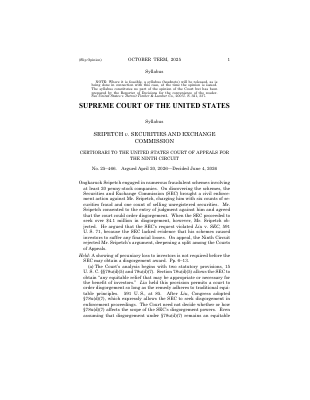
Decided June 4, 2026. The Supreme Court held that a showing of pecuniary loss to investors is NOT required before the SEC may obtain a disgorgement award under 15 U.S.C. 78u(d)(5) or 78u(d)(7).
Decision
BrynoDC Coverage 2 videos
Opinion of the Court
The Facts
Charles Sripetch ran penny-stock pump-and-dump schemes, selling unregistered securities to investors who had no access to the disclosures federal law requires before they put their money in. He was criminally convicted, served 21 months in federal prison, and then the SEC came after his profits in a separate civil action. Sripetch's defense: no investor actually lost money. Nobody filed a complaint. Nobody could point to a dollar they were missing. The question was whether that mattered.
The Issue
Whether the SEC must prove that investors suffered pecuniary loss before it can obtain a disgorgement award, an order forcing the defendant to hand back profits earned from securities violations.
Sripetch argued that disgorgement is an equitable remedy, and equity traditionally requires an injured party. If no investor lost money, there is no one to make whole, and no basis for disgorgement. The SEC argued that disgorgement has never been about compensating victims. It is about stripping the wrongdoer's gain from conduct that violated investors' legally protected interests.
The Rules
In any action or proceeding brought by the Commission under any provision of the securities laws, the Commission may seek, and any Federal court may grant, any equitable relief that may be appropriate or necessary for the benefit of investors.
In any action or proceeding brought by the Commission under any provision of the securities laws, the Commission may seek, and any Federal court may order, disgorgement . . . of any unjust enrichment by the person who received such unjust enrichment as a result of such violation.
The Court held that SEC disgorgement is permissible as a form of equitable relief, but only when it does not exceed the wrongdoer's net profits and is "awarded for victims." The Court left open what "for victims" means and whether victims must have suffered financial loss.
A man opened a tourist cave. A third of the cave extended under his neighbor's land. The neighbor could not access the cave from his own property and suffered no financial loss. The court ordered the cave operator to surrender a third of his profits. Disgorgement measures the wrongdoer's gain from invading another's rights, not the other party's loss.
The Court held that the Seventh Amendment requires a jury trial when the SEC seeks civil penalties - because penalties are a legal remedy, not an equitable one. Thomas's concurrence in Sripetch argues this logic extends to disgorgement after Congress's 2021 codification.
The Application
Before 1929, buying stock was a bet in the dark. Companies had no obligation to tell investors anything about their finances, their debts, or their risks. Investors put their money through a hole in an opaque wall and hoped for the best.
After the 1929 crash wiped out millions of Americans, Congress passed the Securities Act of 1933 and the Securities Exchange Act of 1934. These laws turned the opaque wall into a glass wall. Companies that wanted the public's money had to disclose everything: financial statements, risks, insider transactions. Before investors put a dollar in. The SEC was created to enforce the glass wall: to make sure the wall stays transparent and that nobody sells securities through a hole the public can't see through.
Sripetch sold stocks through the old opaque wall. His investors couldn't see what they were buying. That he may not have cost them money misses the point. He took away their right to see.
Gorsuch's opinion reaches for a case from 1936 Kentucky to explain why pecuniary loss is irrelevant to disgorgement.
A man opens a tourist cave. A third of the cave runs under his neighbor's property. The neighbor has no entrance from his own side. He never loses a dollar. The court orders the cave operator to hand over a third of his profits anyway.
The principle: disgorgement isn't about making the victim whole. It's about making the wrongdoer give back what he gained from invading someone else's rights. It doesn't matter that the neighbor couldn't reach the cave himself. It doesn't matter that no one filed a complaint. The cave operator used what wasn't his. He gives back what he made.
That's exactly what Sripetch did. He bypassed the disclosure system, the transparency that investors are legally guaranteed before they put their money in, and profited. Whether any individual investor can point to a dollar they lost is beside the point. He gained from invading their rights. Disgorgement strips that gain.
Justice Thomas concurred in the result (Sripetch loses) but wrote separately to plant a flag for the next fight.
His argument: in 2021, Congress codified disgorgement as a separate remedy in §78u(d)(7), pulling it out of the general equitable relief provision. By giving disgorgement its own statutory basis, Congress may have transformed it from an equitable remedy into a legal one. If disgorgement is legal rather than equitable, the Seventh Amendment requires a jury trial, the same logic the Court applied to SEC civil penalties in Jarkesy (2024).
No other Justice joined Thomas. But the circuit courts are already split: the Fifth Circuit has applied Jarkesy's reasoning to disgorgement, while the Second Circuit has not. Thomas is telling the bar exactly where to bring the next case.
The Conclusion
**The SEC does not need to prove that any investor suffered pecuniary loss before obtaining a disgorgement award.** Disgorgement is measured by the wrongdoer's gain from violating investors' legally protected interests, not by the victim's financial loss. A unanimous Court affirmed: you used what wasn't yours, you give back what you made.
No circuit court data for this case.
Flag an issue
This tracker is maintained by BrynoDC and is free because readers fund it. Support