
Watson v. Republican National Committee
Decision
BrynoDC Coverage 1 video
Opinion of the Court
The Facts
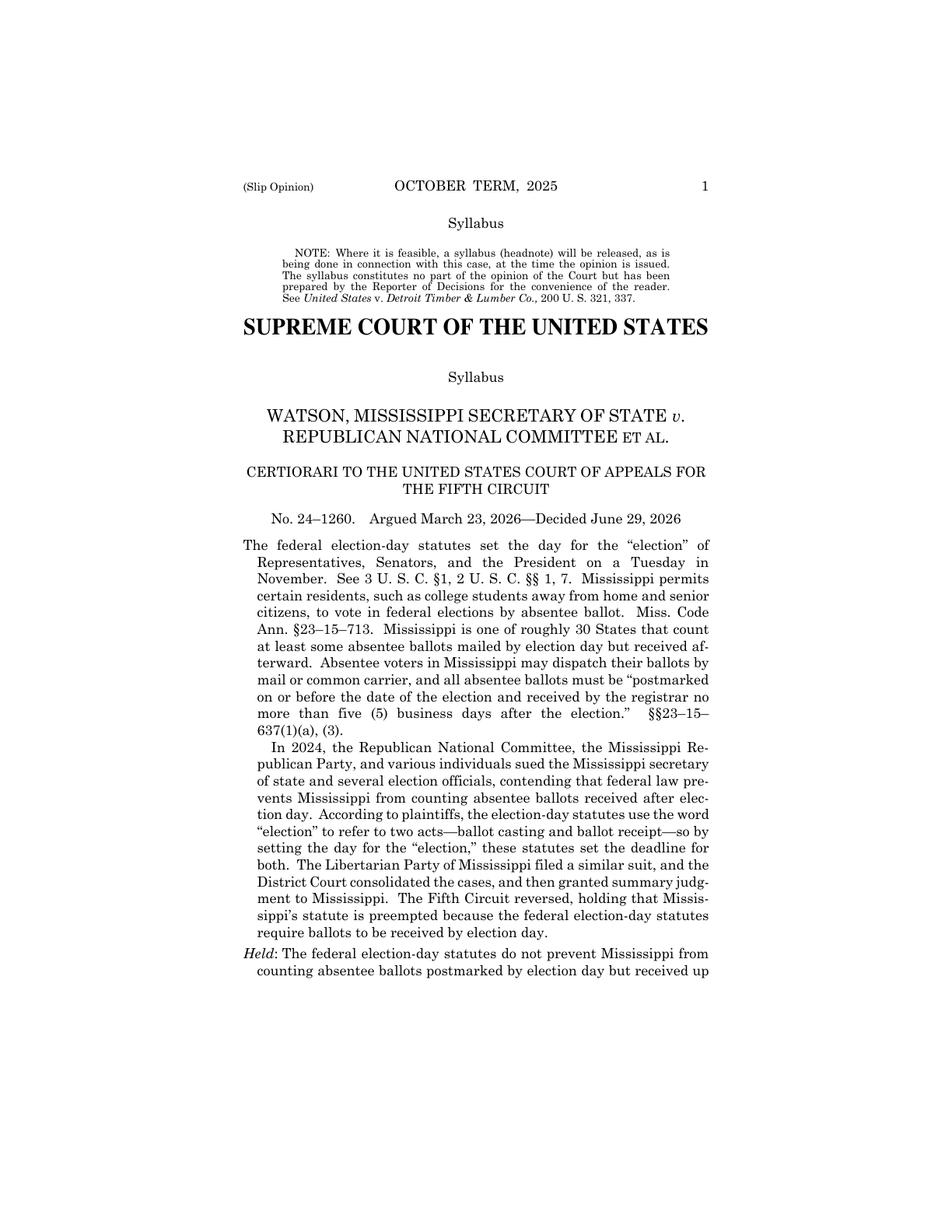
Mississippi law permits mail-in ballots cast by Election Day but received up to five business days afterward — so long as they are postmarked by Election Day — to be counted. The Republican National Committee challenged this practice, arguing that federal statutes fix Election Day as the single day on which federal elections must be completed, preempting state laws that allow post-Election Day receipt of ballots.
The Issue
Whether federal election-day statutes (2 U.S.C. §§ 1 and 7; 3 U.S.C. § 1) preempt state laws that allow mail-in ballots postmarked by Election Day to be received and counted after Election Day.
The Rules
Congress has fixed the Tuesday following the first Monday in November as the day for elections to Congress; the election of Representatives must occur on that day.
Presidential electors must be appointed on the Tuesday after the first Monday in November.
Federal law is the supreme law of the land, and state laws in conflict with valid federal statutes are preempted.
The Application
Watson, Mississippi's Secretary of State, defends the state's right to count mail-in ballots received within five days of Election Day if postmarked by Election Day. States have traditionally controlled election administration details, and federal statutes set the day for casting votes, not a rigid deadline for ballot receipt by election officials.
The RNC argues federal election-day statutes establish a single 'Election Day' for federal races, and votes must be received — not merely cast — by that date. State provisions allowing late-arriving ballots to be counted are preempted by federal law. The Fifth Circuit agreed, striking down Mississippi's late-receipt window.
Argued March 23, 2026. During oral argument, the Court 'appears ready to overturn state law allowing for late-arriving mail-in ballots.' More than 20 states allow post-Election Day receipt of mail ballots — a ruling for the RNC could invalidate all those provisions for federal races, affecting millions of voters and the 2026 midterms.
The Conclusion
The federal Election Day statutes do not preempt state laws on counting absentee ballots.
“By setting the day for the ‘election,’ these statutes set the day when the electorate must make its choice.”
No circuit court data for this case.
Flag an issue
This tracker is maintained by BrynoDC and is free because readers fund it. Support