
Wolford v. Lopez
Case Overview
This is a U.S. Supreme Court case about whether Hawaii's law presumptively banning carrying firearms on private property open to the public, unless the owner gives express consent, violates the Second Amendment under the standard set in Bruen. The case was argued before the Court on the same day, with oral arguments presented by both sides and questions from the justices. No decision or ruling has been issued yet, as the case is currently awaiting the Court's judgment.
Decision
6-3BrynoDC Coverage 1 video
Opinion of the Court
The Facts
Following the Supreme Court's Bruen decision establishing a historical-tradition test for Second Amendment challenges, Hawaii enacted a law presumptively banning firearms on private property open to the public — restaurants, stores, and parks — unless the owner explicitly consents. Gun owners challenged the law as an unconstitutional restriction on the right to bear arms in public, creating a significant test of how broadly states may designate 'sensitive places.'
The Issue
Whether Hawaii's law presumptively banning firearms on private property open to the public unless the owner expressly consents violates the Second Amendment under the historical-tradition test of Bruen; and what historical analogues justify sensitive-place restrictions on public carry.
The Rules
A well regulated Militia, being necessary to the security of a free State, the right of the people to keep and bear Arms, shall not be infringed.
The government must demonstrate that a firearm regulation is consistent with the Nation's historical tradition of firearm regulation.
The Second Amendment protects an individual right to keep and bear arms for traditionally lawful purposes, including self-defense in the home; sensitive places may be excepted.
The Application
Petitioners argue ordinary commercial spaces — restaurants, shops, parks — are not 'sensitive places' under Bruen's framework. Hawaii's default-prohibition scheme flips the constitutional presumption: licensed carriers should be able to carry everywhere unless specifically restricted. No founding-era tradition supports blanket bans on firearms in ordinary commercial establishments.
Hawaii argues its law is consistent with historical traditions of regulating firearms in public gathering places. Private property open to the public — where large numbers gather — has always been subject to safety regulation. The default-prohibition structure respects private property rights by letting owners choose whether to allow firearms.
Argued January 20, 2026. During oral argument, the Court 'appears sympathetic to gun owners' challenge.' The Trump DOJ sided with petitioners against the state — an unusual alignment. The ruling will define Bruen's 'sensitive places' boundary: whether it extends to all commercial spaces or is limited to traditional sites like government buildings, schools, and courthouses.
The Conclusion
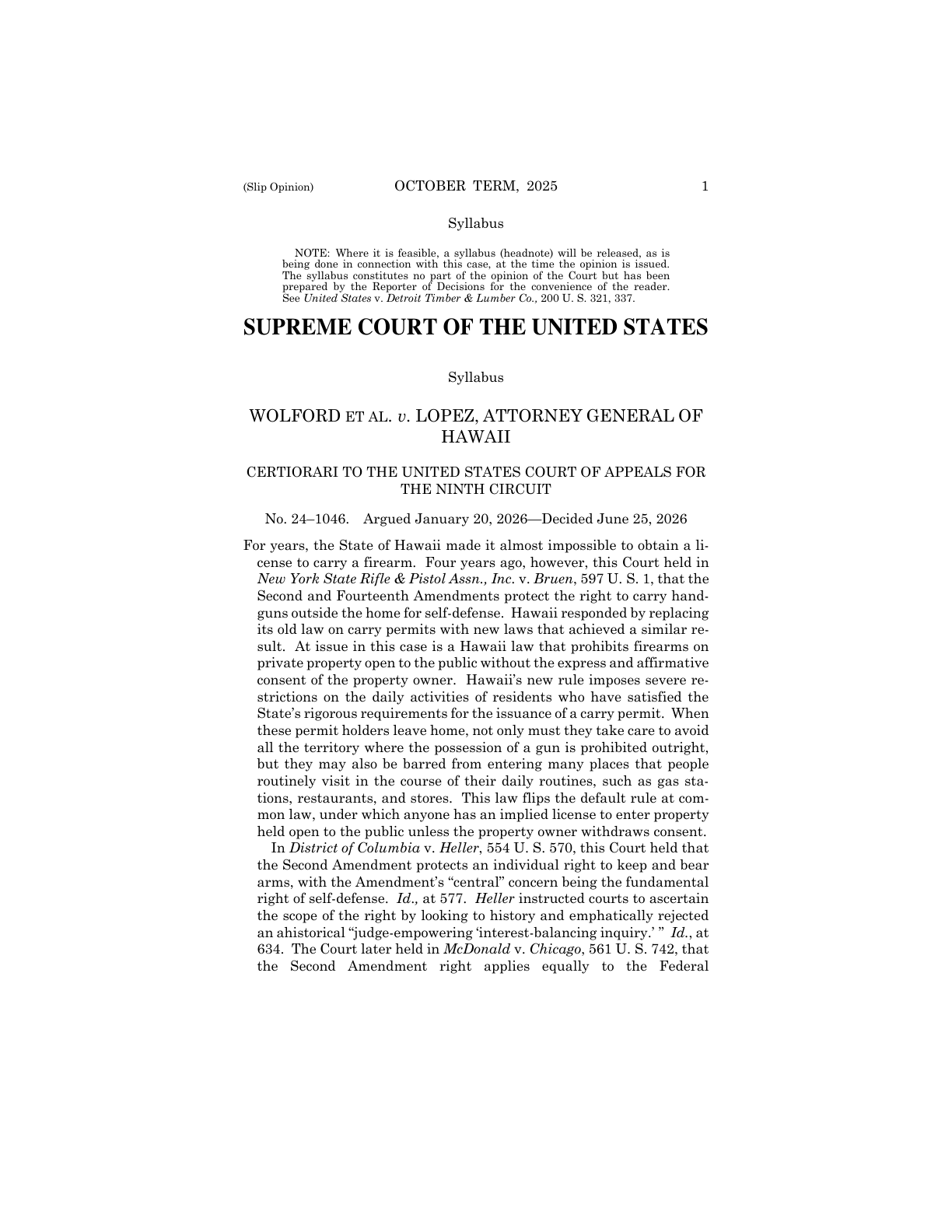
Hawaii's law prohibiting licensed carry permit holders from carrying handguns on private property open to the public without the owner's express consent violates the Second and Fourteenth Amendments. Alito, 6-3. Reversed and remanded. Barrett concurs (Thomas + Gorsuch join Part II-B). Kagan dissents. Jackson joined by Sotomayor dissents.
No circuit court data for this case.
Flag an issue
This tracker is maintained by BrynoDC and is free because readers fund it. Support