
Becerra v. Empire Health Foundation
The Facts
Empire Health Foundation operates safety-net hospitals in Washington State that serve substantial Medicaid and Medicare populations. Medicare's disproportionate share adjustment turns on the fraction of patient days attributable to patients entitled to Medicare Part A benefits. The Department of Health and Human Services excluded from the Medicare fraction patients who were entitled to Medicare Part A but whose care was paid by a third-party insurer, which reduced Empire's DSH payments by millions of dollars annually. Empire challenged the exclusion as contrary to the statute's text.
The Application
In applying the statutory language "entitled to benefits under part A," the Court rejected HHS's administrative interpretation that required actual Medicare payment to trigger DSH adjustment eligibility. Empire's Medicare-enrolled patients, even when third-party insurers covered their care, fell squarely within the statute's text based on their enrollment and eligibility status alone, not payment performance. By anchoring the analysis in the word "entitled" rather than on reimbursement outcomes, the Court's textual approach required HHS to restore these patient days to Empire's Medicare fraction, thereby increasing its supplemental payments and reflecting its genuine role as a safety-net provider serving a substantial Medicare-eligible population.
The Conclusion
**The ruling requires HHS to count all Medicare-entitled patients in the DSH fraction regardless of who actually pays the bill.** Safety-net hospitals that serve large Medicare populations receive higher supplemental payments as a result. The decision was grounded in statutory text rather than agency deference.
No circuit court data for this case.
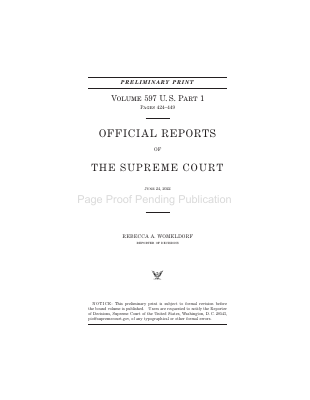
Case Analysis
Overview
The Supreme Court resolved a statutory dispute over how Medicare calculates disproportionate share hospital payments, which supplement reimbursement for hospitals serving high proportions of low-income patients. Justice Kagan wrote for a 5-4 majority, holding that patients who are enrolled in and entitled to Medicare Part A must be counted in the Medicare fraction even when Medicare is the secondary payer and pays nothing toward the hospital stay.
Facts
Empire Health Foundation operates safety-net hospitals in Washington State that serve substantial Medicaid and Medicare populations. Medicare's disproportionate share adjustment turns on the fraction of patient days attributable to patients entitled to Medicare Part A benefits. The Department of Health and Human Services excluded from the Medicare fraction patients who were entitled to Medicare Part A but whose care was paid by a third-party insurer, which reduced Empire's DSH payments by millions of dollars annually. Empire challenged the exclusion as contrary to the statute's text.
Issue
Whether Medicare patients who are enrolled in and entitled to Part A benefits must be counted in the Medicare fraction of the DSH calculation even when Medicare is the secondary payer and covers none of the patient's costs.
Rule
42 U.S.C. Section 1395ww(d)(5)(F) establishes the disproportionate share hospital adjustment and uses the phrase 'entitled to benefits under part A.' The interpretive question is whether entitlement is defined by enrollment status or by actual Medicare payment.
Analysis
In applying the statutory language "entitled to benefits under part A," the Court rejected HHS's administrative interpretation that required actual Medicare payment to trigger DSH adjustment eligibility. Empire's Medicare-enrolled patients, even when third-party insurers covered their care, fell squarely within the statute's text based on their enrollment and eligibility status alone, not payment performance. By anchoring the analysis in the word "entitled" rather than on reimbursement outcomes, the Court's textual approach required HHS to restore these patient days to Empire's Medicare fraction, thereby increasing its supplemental payments and reflecting its genuine role as a safety-net provider serving a substantial Medicare-eligible population.
Conclusion
**The ruling requires HHS to count all Medicare-entitled patients in the DSH fraction regardless of who actually pays the bill.** Safety-net hospitals that serve large Medicare populations receive higher supplemental payments as a result. The decision was grounded in statutory text rather than agency deference.
Notes
OT2021. Added via SCOTUS bulk import 2026-05-14
Flag an issue
This tracker is maintained by BrynoDC and is free because readers fund it. Support